
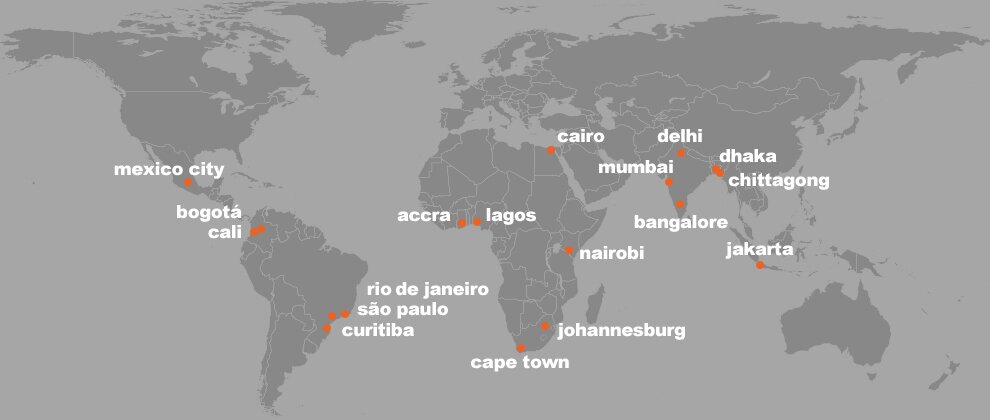
Access to food for Mexico City's vulnerable populations
 Mexico City has a high level of income per capita, but the distribution of income is highly unequal. This high inequality is partly responsible for the 13.4 percent of Mexico City's population that suffers from malnutrition. According to the Consejo Nacional de Evaluación de la Política Social (the National Council for the Evaluation of Social Development Policy), this population is below the poverty line, and cannot afford the $1,177.04 pesos ($96.47 USD) that it takes, on average, to feed one person for a month. Read more or join the discussion.
Estrategias de alimentación para la población vulnerable en el DF
El Distrito Federal cuenta con un alto nivel de ingresos per cápita; sin embargo, la distribución de los ingresos es de alta desigualdad. Este grado de desigualdad dejó al 13.4 por ciento de la población del D.F. en pobreza alimentaria. De acuerdo al Consejo Nacional de Evaluación de la Política Social, esta población tiene un ingreso que se encuentra por debajo de la línea de bienestar mínimo y no tiene la manera de recaudar los $1,177.04 pesos necesarios que se necesitan al mes para alimentar a sólo una persona. Leer más o discutir.
La necesaria vinculación de la farmacovigilancia y la farmacoeconomía en México
A partir de hace más de 3 décadas el país ha presentado un crecimiento importante en cuanto a la esperanza de vida se refiere. En este sentido, de acuerdo a datos del Banco Mundial, para 2010 la esperanza de vida en el país era de 76.68 años, cifra únicamente inferior, en Latinoamérica, a la observada por Costa Rica (79.19 años). Leer más.
Planeación urbana participativa
 El Pueblo San Andrés Totoltepec en la Delegación Tlalpan ha sido parte de una metodología de planeación urbana instrumentada por la Organización Fomento Solidario de la Vivienda (FOSOVI). Dicha organización busca desarrollar el diseño y planteamiento del hábitat popular a través de metodologías participativas, y que incida en el diseño de las políticas públicas. El eje central de esta metodología es un proceso dinámico basado en la capacidad y voluntad de la sociedad para guiar su propio destino. Este proceso parte de la Investigación-Acción-Participativa; una herramienta que vincula la reflexión, el diálogo, la acción y el aprendizaje entre los actores involucradas y externos para promover el empoderamiento de las comunidades excluidas de los procesos socio-políticos. Leer más o discutir.
Participatory urban planning
The town of San Andrés Totoltepec, located in the administrative borough of Tlalpan, has been part of an urban planning methodology implemented by the Organización Fomento Solidario de la Vivienda — FOSOVI (the Social Fund for Housing). This organization uses participatory methodologies to design public policy; the core is to create a dynamic process based on the capacity of society to guide its own future. This is known as participatory action research, a tool that links reflection, dialogue and the knowledge of the actors involved in order to promote the empowerment of excluded communities in the process of public policy. Read more or join the discussion.
Servicios básicos para asentamientos urbanos pobres y marginados
 El rápido crecimiento en las urbes ha tenido como consecuencia a la reproducción de espacios de diferenciación social donde se reproduce la marginación y la pobreza. En este sentido, actores en la esfera internacional promueven el bienestar de las personas que viven en estas condiciones. La declaración de la Cumbre de Estambul de 1996, propuso la realización de Agendas Hábitat para establecer planes de acción que brindaran soluciones a los rezagos sociales, entre ellas "vivienda adecuada para todos" y "desarrollo de asentamientos humanos sostenibles en un mundo en proceso de urbanización". Leer más o discutir.
Basic services for poor and marginalized urban settlements
The rapid growth of major cities has led to the reproduction of marginalization and poverty in increasingly unequal societies. This is emphasized by the creation of under-served areas in the outskirts of cities, where the marginalized population has been distanced from the better socioeconomic conditions and social infrastructure that the city center has to offer. International actors have therefore worked to promote the welfare of of the poor living in these unequal conditions in order to link them with prosperous zones. The 1996 Istanbul Summit Declaration resulted in the Habitat Agendas, which propose a plan of action with regard to human settlement issues, including "proper housing for all" and "sustainable settlement development for humans in an urbanizing world." Read more or discuss.
Alternativas de bienestar para los migrantes de la Cd. de México
 En México la migración es el principal determinante del crecimiento demográfico; la diversificación de las actividades económicas ha propiciado la aparición de polos de atracción alternativos que influyen en la movilidad territorial. El Distrito Federal desde los años cincuenta ha sido un lugar de destino de corrientes migratorias de otras entidades federativas, así como de migración intermunicipal en el área de la Zona Metropolitana de la Ciudad de México. Actualmente el DF ya no representa el principal polo de atracción en México, aunque sigue recibiendo migrantes temporales, de tránsito y de residencia. Leer más o discutir.
Welfare alternatives for migrants to Mexico City
In Mexico, migration is the principal determinant of demographic growth: the diversification of economic activities has contributed to the rise of alternative poles of attraction that influence territorial mobility. Ever since the 1950s, Mexico City has been a destination for migratory waves from other states, as well as inter-municipal migration in the city's Metropolitan Zone. Mexico City is now no longer the main destination pole in Mexico, although it does continue to receive temporary transitory and residential migrants. Read more or join the discussion.
Agricultura urbana y cooperativismo hace frente a la pobreza en Iztapalapa
 La pobreza en la ciudad de México, al igual que en otras metrópolis, tiene muchas caras. Citando a Caroline Moser, los pobres de las ciudades dependen de un ingreso que se vincula con la acumulación del resto de sus capitales. Una de las tantas caras de esta pobreza es el acceso a alimentos, pues bien la falta de ingresos limita una alimentación adecuada y necesaria para que el cuerpo humano sea productivo. Leer más o discutir.
Pages
New Cities Summit in São Paulo: The Human City (Part 1)
 Influential policy makers, academics, innovators, entrepreneurs, and social and urban development practitioners are currently gathered in São Paulo for a two-day summit organized by the New Cities Foundation. The event focuses on the current challenges that cities face becoming more just and inclusive. Read more.
Inclusion and racial equality in São Paulo: Implementing an effective quota system in state universities
 In 2010, Brazil passed a law on racial equality in order to reduce racial discrimination and to promote greater social inclusion among excluded groups. But even with this law, the dark-skinned, black, and indigenous populations continue to face discrimination. One of the areas where this is most evident is with regard to access to higher education. Read more or join the discussion.
Inclusão e igualdade racial em São Paulo: Construção de um sistema efetivo de cotas nas universidades estaduais
No Brasil o Estatuto da Igualdade Racial foi aprovado em 2010 como um conjunto de regras que visam diminuir a discriminação racial e a desigualdade social existente no país. Embora o estatuto tenha sido aprovado, ainda as populações pardas, negras e indígenas continuam sendo excluídas; uma área onde esta situação é evidente é no aceso à educação superior. Leia mais ou discutir.
Pages
- « first
- ‹ previous
- 1
- 2
- 3
- 4
Empoderamento dos trabalhadores domésticos por meio de legislação adequada, salario justo e aceso a informação
 Os trabalhadores domésticos são um grupo bem importante no mercado laboral, especialmente para Ásia e América Latina. Este grupo de trabalhadores inclui governantas, cozinheiros, babás, faxineiros, motoristas particulares e jardineiros, entre outros. Vários países em desenvolvimento apresentam uma histórica ausência de reconhecimento formal a estes trabalhadores, contribuindo ao estabelecimento de horários de trabalho não regulamentados, carência de salários justos e de proteção social. Mais a partir de Março 2013 a situação vai a mudar com a aprovação e efetividade da emenda constitucional que assegura aos domésticos direitos iguais aos demais trabalhadores. Alguns dos direitos estabelecidos para os trabalhadores domésticos incluem: jornada de trabalho de 44 horas semanais, com limite de oito horas diárias, pagamento de horas extras e o reconhecimento dos acordos coletivos de trabalho. Leia mais ou discutir.
Empowering domestic workers through adequate legislation, fair compensation, and access to information
Domestic workers — maids, cooks, baby sitters, gardeners, drivers, and so on — are a very important group within the labor market, especially in Asia and Latin America. However, domestic workers traditionally lack formal recognition, meaning that they have non-regulated working hours and lack proper compensation and access to social protection. With the constitutional amendment of March 2013, this situation has begun to change: the law requires minimum working conditions for domestic workers, putting them on a par with other salaried workers. The new rights include a regulated workload with a maximum of 8 hours a day or 44 hours a week, paid overtime, and the recognition of labor unions to ensure collective rights. Read more or join the discussion.
Good food is just around the corner: Rio de Janeiro's first Favela Gastronomic Guide
 Good and nutritious food is accessible to all of Rio's residents, no matter where they live. At least this is the message from Sérgio Bloch, Ines Garçoni and Marcos Pinto, the authors of the new "Guia Gastronômico das Favelas do Rio", or "The Gastronomic Guide to Rio's Favelas", the first of its kind. Read more or join the discussion.
Boa comida ao alcance de todos: O primeiro Guia Gastronômico das Favelas do Rio
Comida gostosa e nutritiva está ao alcance de todos os moradores de Rio, sem importar onde eles moram. Este parece ser a mensagem de Sérgio Bloch, Ines Garçoni e Marcos Pinto, os autores do "Guia Gastronômico das Favelas do Rio", que foi lançado o mês passado. Leia mais ou discutir.
Rio's Master Plan
 Planning the medium and long-term development of a city is not an easy task — it requires a clear framework and effective tools. In order to understand how planning takes place in Rio de Janeiro, it is important to look at the highlights of the Brazilian planning framework, and then how it is implemented at the city level. Read more or join the discussion.
Plano Diretor do Rio de Janeiro
Planejar o desenvolvimento urbano das cidades no médio e longo prazo é um grande desafio. Para compreender melhor o processo de planejamento urbano no Rio de Janeiro, é importante descrever o marco do planejamento no Brasil para logo compreender melhor sua implementação ao nível da cidade. Leia mais ou discutir.
Integrando os bairros de baixa renda à 'cidade formal' por meio de transporte e emprego
 Neste mapa do Rio de Janeiro, os bairros de baixa renda estão identificados em laranja, facilitando nossa compreensão sobre sua localização. Aquele mapa também nos permite aprender que estes bairros não estão localizados numa única área, mais que eles estão distribuídos pela cidade toda, desde o centro até a periferia, com concentrações na zona norte e oeste. Segundo o último censo nos sabemos que aqueles "pontos laranja" são residência de 20 por cento da população da cidade ou 1,2 milhões de pessoas. Leia mais ou discutir.
Linking informal settlements to the 'formal city' through better transportation and access to employment
In this map of Rio de Janeiro, low-income neighborhoods are identified in orange, providing an easy understanding of their physical distribution. This map also shows that low-income neighborhoods are not located in a particular area of the city, but are spread out from the center to the outskirts, although with higher concentrations in the northern and western areas. The latest census shows that these "orange spots" are home to 1.2 million residents, which is equivalent to 20 percent of Rio's population. Read more or join the discussion.
Greater inclusion of northeastern populations in Rio de Janeiro
 In Rio de Janeiro, there is no specific group that can be clearly classified as the "new urban poor." There is no single large group of recently arrived migrants that have become the poorest of Rio's groups. However, there is a special group that deserves our attention: the migrants from Brazil's Northeast region, who migrated to Rio six decades ago, but are still one of Rio's poorest and most excluded populations. Their migration took place between the late 1940s and the 1970s, when a large number of agriculturalists from the northeast migrated to São Paulo and Rio de Janeiro in search of better paying jobs in civil construction. Read more or join the discussion.
Maior inclusão da população nordestina no Rio
No Rio de Janeiro existe um grupo populacional que merece uma atenção especial: Os migrantes nordestinos e seus descendentes, que com mais de sessenta anos no Rio continuam como uma das populações mais pobres e excluídas da cidade. A migração de nordestinos para São Paulo e Rio de Janeiro aconteceu entre as décadas de 1940 e 1970, onde um número importante de agricultores nordestinos passou a migrar para aquelas cidades em busca de melhores oportunidades de trabalho na construção civil. Leia mais ou discutir.
Pages
A school that floats: Drawing from local inspirations and design in Makoko
 In Makoko, residents' houses and lives, many built on stilts, hover over the polluted, dark waters of the Lagos waterfront and lagoon. But contrary to the perception of the community as a development blight and hurdle to the city's forward development, the design and urbanism firm NLÉ wants to show that Makoko is an inspiration and a model of adaptation for Africa's coastal cities: the firm has designed a prototype school, currently under construction, to float on Makoko's waters, marking an innovative adaptation to challenging circumstances. Read more or join the discussion.
Rethinking transportation in Lagos
Lagos is in a transportation crisis. A city of close to 15 million persons, Lagos is larger than London, but without a train system corresponding to the London Tube. A combination of bad roads, too many cars and trucks, and frequent accidents means that the city is often gridlocked. Everyone who can afford a car buys one, since what passes for public transportation is largely inhospitable — a network of tens of thousands of mini-buses known locally as danfos. In the last few years the government has introduced a bus system that takes advantage of dedicated lanes, but its capacity is a far cry from what is needed. In any case it still has to depend on the overburdened road network. The motorcycle taxis (okadas) that once dominated and defined the metropolis, providing an opportunity for time-challenged travellers to weave through traffic jams, have recently come under the government's hammer. Without radical and intelligent solutions the situation is bound to worsen, as Lagos is Africa's fastest growing city, and the World Bank estimates that there will be more than 20 million people in it by 2020. What is clear is that Lagos cannot hope to make a dent on its traffic situation without forms of mass transportation that can convey large numbers of people outside of the road network. The solutions will lie on land — rail lines — and in the water. Read more.
Event: Social Media Week Lagos 2013: Open and Connected
18–22 February 2013  Lagos, Nigeria
Social Media Week is a worldwide event exploring the social, cultural and economic impact of social media. Our mission is to help people and organizations connect through collaboration, learning and the sharing of ideas and information.
February 2013 will mark the first time Social Media Week takes place on the continent of Africa! Social Media Week Lagos brings together thought leaders, creatives, entrepreneurs and everyday citizens from Nigeria – and throughout the continent and the diaspora - to explore how people and organizations are connecting to share new ideas and information.
"By programming keynotes and panels that look at how Africans – Nigerians in particular – are incorporating social media in their unique social, political, and creative landscapes, Social Media Week Lagos will explore just how important being connected to the world is for 21st century Africans" – Ngozi Odita, Executive Director of Social Media Week Lagos. Learn more.
Event: Nigeria Summit 2013: Enabling and Implementing the Change
19–20 March 2013 Lagos, Nigeria
Nigeria has a young and growing population, a wide range of natural resources and a government full of internationally renowned reformers yet life for the average Nigerian is not improving. There’s no shortage of visions that see Nigeria transformed into a dynamic, competitive economy where entrepreneurialism and innovation thrives. But the real need is for action at all levels. Bringing together 180+ international business leaders, investors, policymakers and influential commentators, our flagship Nigeria Summit will focus on what is being done to execute the vision. Learn more.
LagosPhoto Festival brings art to the community via public spaces
 The innovative element of the LagosPhoto Festival is its emphasis on community and public accessibility. In a time and space where artistic appreciation is often a privilege few can afford, the festival brings contemporary art — in this case, photography — to the public by siting exhibitions in key community locations. This year, public spaces like Muri Okunola Park in Victoria Island, Falomo Roundabout in Ikoyi, Oworoshoki-Alapere Median, and UBA Park at the University of Lagos in Yaba are among the festival's key venues. Learn more.
From margins to spotlight: unlocking youth creativity through art
 In marginalized Lagos communities like Ajegunle and Oshodi, the BornTroWay Creative Arts Project is empowering and spotlighting youth art creativity. The project started in Ajegunle, considered one of Lagos' harshest slum settlements — but also a thriving place where some of the country's premier athletes and performers have grown up. For its youth participants, BornTroWay is making a difference that goes far beyond teaching them to dance, to act, to write a song or rap. Read and discuss.
Makoko residents pursue their right to remain
 In July, the Lagos State Government razed the homes, businesses, and livelihoods of more than 20,000 residents of the waterfront community of Makoko, a major slum in the megacity. The recent destruction of homes and livelihoods is not a new phenomenon in this waterfront community: Seven years ago, in April 2005, the government led a similar exercise, demolishing houses, churches, shops, and community health clinics, and displacing more than 3,000 people. The trend of these demolitions, and similar ones in Lagos State and across the country over the past few years, highlights the insecure position of land tenancy and title for residents in informal communities and slums like Makoko. Read and discuss.
Using education to empower out-of-school girls in Lagos
 Young girls in low-income, informal settlements such as Iwaya, a waterfront settlement in Lagos, must grow up fast: they are often the informal solution for their families as they struggle with the daily issues of income and infrastructure access. Such responsibilities often force these girls to forego their education to tend to the immediate needs of their households — and without an education, they remain at a distinct disadvantage for the rest of their lives. Action Health Incorporated develops educational solutions that are accessible for out-of-school adolescent girls — starting in Iwaya — to help stem this cycle of poverty. Read and discuss.
Clean drinking water in Lagos: many options, few solutions
 In Lagos, the systemic challenges facing urban water infrastructure affect each and everyone, from the wealthy oga in his corner office on Victoria Island to the impoverished beggar eking out his subsistence on a walkway in one of the city's slums. Fewer than 30 percent of the population has access to piped water connections of any kind, and even they must contend with erratic access; meanwhile, for those fetching water at community water points, even when water does flow, it is often anything but drinkable. In short, the shortcomings of government intervention leave a vast gap between supply and demand and have transformed water, especially potable water, into an essential commodity. Read and discuss.
Urban infrastructure for water, waste and sanitation: the role of civil society
 Rapid urbanization through natural growth and rural-to-urban migration is overwhelming cities in the emerging world — cities which are already struggling to develop their infrastructure. Lagos, where guest contributor Olatunbosun Obayomi has lived all his life, is no exception. The United Nations estimates that the city's population will hit 16 million by 2015, making it the world's 11th-largest urban system. Its population density has already reached an extreme level at 4,193 people per square kilometer. Meanwhile, a combination of official neglect, corruption, extreme poverty, and rapid, largely uncontrolled population growth has led to the decay of the existing urban infrastructure — a key determinant of how livable the city will be. Read and discuss.
Pages
Encouraging collective action for water management and conservation
 Compared to other countries in the Middle East and North Africa, Egypt is much better off with regards to access to freshwater resources, primarily thanks to the Nile. With the majority of the country's population densely situated along the river basin, government statistics show that 99 percent of the country's population has access to water, and access in urban areas is 100 percent. However, these statistics drown the many other political, social and economic issues that surround the water sector. Read more or join the discussion.
تشجيع الإجراءات الجماعية لإدارة المياه والمحافظة عليها
إذا قارنا موارد المياه العذبة المتوفرة بمصر بموارد مياه الدول الاخرى في الشرق الأوسط وشمال أفريقيا, نجد أن مصر لديها أكثر كميات من المياه العذبة، و ذلك بفضل نهر النيل العظيم. تشير احصاءات الحكومة أن ٩٩ في المئة من سكان البلد يحصلوا على المياه بطريقة ما, بسبب تواجد معظمهم بجوار نهر النيل. اظهرت الاحصاءات أيضا أن المياه العذبة متوفرة لجميع سكان المناطق الحضرية, ولكن تجاهل هذه الاحصاءات العديد من القضايا السياسية والاجتماعية والاقتصادية التي تظهر في قطاع المياه بمصر.
Escaping the informal sector on the streets
The concept of being homeless in Cairo doesn't follow the traditional patterns seen in the Western hemisphere because of the prominence of Ashwa'eeyat, or slum villages within the city. Most often these are unfinished buildings in which entire families live squashed together in one or two rooms, with hardly any furniture or access to electricity, gas, or running water. The lack of basic services and an adequate standard of living places significant strains on the family. It is common that the children not only perform many of the household duties, but also are left beaten and neglected as their reward. Their only escape from this lifestyle is to run away and find refuge on the street. Read more or join the discussion.
الهروب من العشوائيات إلى الشوارع
ظاهرة التشرد في القاهرة تختلف عن نفس الظاهرة في بلاد الغرب بسبب إنتشار العشوائيات بمصر. في أغلب الحالات تتكون هذه العشوائيات من مباني غير مكتملة, تعيش فيها عائلات بأكملها في مجرد حجرة أو حجرتين دون فرش، لا تصل لهم الكهرباء أو المياه الجارية, و ليس هناك طريقة مباشرة للحصول على الغاز الطبيعي. مستوى المعيشة غير ملائم, و مشكلة عدم وجود الخدمات الأساسية في هذه المناطق تضع ضغوطا كبيرة على الأسرة. تقوم الأطفال بتنفيذ العديد من الواجبات المنزلية، و لا يحصلون على أي نوع من المكافأة, بل يتعرضون للضرب والإهمال. لذلك، فمن الشائع أن تهرب الاطفال من المنزل لكي تبحث عن اللجوء في شوارع القاهرة.
Beit Hawa: Cairo's first comprehensive women's shelter
 It is certainly difficult to walk in the streets of Cairo as a woman without being catcalled at least once. But lewd comments are the least threatening form of sexual assault that occurs. According to the Survey of Young People in Egypt (SYPE), almost 44 percent of all females have experienced sexual harassment, with the highest prevalence in urban areas. Moreover, reports have shown that cases of gender-based violence have become more common since the revolution. This increase has been attributed to the dilapidation of state security forces and the emancipation of the general public from the previously oppressive police force. The issue of violence against women in Egypt, however, is deeply rooted in public opinion on gender roles. Read more or join the discussion.
بيت حواء : أول منظمة نسوية متكاملة لحماية النساء في القاهرة
من الشائع أن تتلقى المرأة المصرية بتعليقات سلبية وألفاظ بذيئة حينما تتجول في شوارع القاهرة, وقد تصاب السيدات بعدة أنواع من التحرش أكثر جلف من هذه التعليقات. يبلغ عدد النساء المصرية التي تعرضت للتحرش الجنسي حوالي٤٤ في المئة من مجموع الاناث في مصر وفقاً لتقرير، و قد ترتفع هذه النسبة بشكل مفاجئ في المناطق المدنية. أظهرت تقارير أيضا أن حالات العنف ضد المرأة ازدادت بشكل واضح منذ ثورة ٢٥ يناير, ويعزى هذا الارتفاع إلى اندثار قوات أمن الدولة التي كانت تقمع الشعب.
Football tournaments for peace
 In response to the increasing violence that has spread around Egypt in the wake of the second anniversary of the January 25 revolution, President Mohamed Morsi's latest action has been to implement both a curfew from 9pm to 6am, as well as a state of emergency law in the governorates of Port Said, Suez, and Ismaileya. Political activists and organizations immediately began to organize mass protests and to mobilize residents to take to the streets starting at 9pm. However, the one initiative that received the most media attention, both through social and cable news outlets, was not the "million man march" declared in Port Said; it was the football tournament that was announced via Twitter and Facebook. Read more or join the discussion.
Pages
- « first
- ‹ previous
- 1
- 2
- 3
- 4
Pre-election art and political engagement in Nairobi
 In the early hours of Monday 11 February, as Kibera residents set off to work, they were treated to the sight of a brightly painted train passing through the heart of their slum. This was the Kibera peace train, a collaborative effort of members of the community-based organisation Kibera Hamlets, Nairobi's celebrity graffiti writers Spray Uzi, and many other Kenyan artists who turned up at the city's railway station the previous Sunday to paint the entire side of a train with messages of peace and unity. The project, which was endorsed by the Rift Valley Railways, is another episode in a long line of political artistic campaigns targeting Kenyan citizens and politicians in the run-up to the elections this coming 4th of March. Read more or join the discussion.
Yoga for development
 Every Thursday at 10am a motley group of people gathers in a circle in Nairobi's Arboretum, a small park that lies adjacent to the president's compound, to engage in an intense two-hour session of power yoga. Anyone can attend the practice free of charge and the occasional Mzungu (white person) or Mhindi (Indian) has been known to take advantage of this unique class. Nevertheless, the main component of the group are youngsters who hail from the poorer part of Kangemi, a neighbourhood on the north western periphery of Nairobi. Read more or join the discussion.
New approaches to transportation undermine Nairobi's economy
 The Kenyan Traffic (Amendment) Act 2012 came into force at the end of last November amidst widespread Public Service Vehicle (PSV) worker strikes and scepticism as to how effective it would be. The objectives of the introduced regulations were to minimize carnage on the roads by imposing steep penalties for those who commit traffic offences or engage in reckless driving. The main targets for the new penalties are the 14-seater PSVs — commonly known as matatus. These mini vans are widely considered to be the main source of Nairobi's traffic delirium, and calls to do something about them have been mounting over time. Read more or join the discussion.
New approaches to transport undermine Nairobi's economy
 The Kenyan Traffic (Amendment) Act 2012 came into force at the end of last November amid widespread Public Service Vehicle (PSV) worker strikes and scepticism as to how effective it would be. The objectives of the introduced regulations were to minimize carnage on the roads by imposing steep penalties for those who commit traffic offences or engage in reckless driving. The main targets for the new penalties are the 14-seater PSVs — commonly known as matatus. These mini vans are widely considered to be the main source of Nairobi's traffic delirium, and calls to do something about them have been mounting over time. Read more or join the discussion.
Case study: Data collection in a Nairobi slum-upgrading project
 In order to engage in urban poverty reduction, it is essential to have a clear understanding of the nature of the area to be targeted and the essence of the problems faced by the people there. During the Huruma slum-upgrading project, the Italian NGO COOPI collaborated with Pamoja Trust to come up with a participatory data collection technique to identify the needs of the community. Chiara Camozzi, an architect who works at COOPI and closely followed the project through its different phases, agreed to talk to urb.im and explain how the data was collected and later used. Read more or join the discussion.
Old construction methods plus new designs in a Mathare school
 The Why Not Academy is a shiny jewel in the rough heart of Mabatini village wedged onto a terrace on the steep slopes of Mathare. The primary school was first started by Mathare resident and soccer coach Dominic Otieno in 2000 after he discovered that most of the youth he worked with were having trouble attending school. What began as an academic study group that Otieno ran from his small room soon began to expand, as more students flocked to attend the informal class. Read more or join the discussion.
Upendo Hero: a 'public space superhero' fights privatization
 Upendo Hero is "a public space superhero," says Kenyan-based public space activist Vincenzo Cavallo — "a defender of public space, a lover of Nairobi, a sworn enemy of gentrification and a soldier against the privatization of public space." Cavallo is one of the founders of the community-based organization Urban Mirror, a group that has run several public space and public art initiatives in Kenya over the last few years. One of the ideas behind Urban Mirror has been to incorporate participatory methodologies as tools in the struggle to reclaim urban public space. Learn more.
Nairobi's Thika superhighway project
 The Thika superhighway, a ten-lane highway that covers the 42 kilometers between Nairobi and Thika, northeast of the capital, is a first-of-a-kind flagship "mega project" launched by the Kenyan government. Its development marks the initial phase of an urban planning strategy aiming to make Nairobi a world-class city by 2030. The highway has raised the quality of life for many residents of adjacent towns and made the commute into central Nairobi relatively painless. Nevertheless, the project has not been accompanied by any concrete pro-poor interventions, and it risks excluding many of the urban poor who might otherwise have benefited from the upgrade. Learn more.
Disabled children in Nairobi's informal settlements
 Mothers of disabled children growing up in under-served informal settlements are faced with a daily uphill struggle to feed, nurture, and care for their children. To exacerbate the issue, there is a higher incidence of disabled children living in slums than in the rest of the city, mainly due to inadequate healthcare women may receive during pregnancies and childbirth and to curable diseases like meningitis — which, if not caught in time, may result in permanent brain damage. According to World Friends, an Italian NGO that runs Neema Hospital, situated in Nairobi's eastern periphery: "Ten percent of children living in slums under the age of 15 are disabled and live in conditions of severe marginalization." Learn more.
Tree planting and climate change in Kibera
 Students of the Undugu Primary School and St Gabriel's School are taking part in a tree-planting drive to reforest a corner of Kibera. The initiative, spearheaded by the Kibera Community Youth Program (KCYP) and run by local environmental volunteers, aims to plant a total of 700 trees using funds donated by British NGO Trees for Cities — which, in collaboration with the KCYP, has created a project that actively encourages communication and dialogue between students, volunteers, and members of the community. Learn more.
Pages
Can India's unique identity initiative influence urban planning?
 Urban India can boggle the mind of even the most seasoned planners. The country's economic growth has put metropolitan areas at the center of aspirations, causing widespread migration from rural villages and towns. With little urban planning on which to base the massive population growth, Mumbai has mushroomed chaotically. Transport, housing, water, sanitation, healthcare and education fall short of residents' most basic needs. Few master plans have moved from theory to action. And frustrated citizens have grown increasingly wary of political inaction. Yet one government program, the country's ambitious Aardhaar initiative — which aims to provide every citizen with a unique identification number — has the potential to return planning to foundational basics on which to base equitable urban development. Read more or join the discussion.
Mumbai's poor create new economic hubs
 Mumbai's unique geography as a peninsula city has styled its expansion in ways dissimilar to other cities. Rapid population growth in other metropolises explodes outwards in multiple directions, forming suburban pockets in unpredictable bursts. In Mumbai, the only possibility is north, making the push away from the central business area more vast with continued expansion. The result for those living in the northern suburbs and on the edge of the city is a longer and longer train commute on one of only two rail lines. Yet studies have found that despite this natural growth pattern, the poor actually continue to work closer to home than their wealthier counterparts, calling into question the importance of connectivity to the traditional economic center of the city. Read more or join the discussion.
Behind the brick walls: children of migrant construction workers
 Mumbai is a city of migrants. Millions of residents have journeyed to the island city from all around the country, bringing a rich diversity of languages, religions, and customs. They come with hopes and dreams of having more than they did in their jobless villages, toiling invisibly in all corners of the city. Many of these migrants are the foundation on which the city is built — literally. Construction is the single largest employer of migrant laborers in India's cities. Both men and women — the poorest of the poor — spend endless hours laying down bricks, carrying cement, chopping away at old roads to bring home a meager living for their families, most of who live right at the sites. Read more or join the discussion.
Bringing a voice to India's red light districts
 India's poor have few media outlets of their own. Their struggles for housing, human rights, basic services, equality, and dignity are told in snippets on the nightly news and in newspaper columns. Their dreams and demands are relayed in brush strokes, leaving aside the important details that humanize their existence. Yet a most unlikely group — women in India's brothels — have pioneered a monthly newspaper that gives voice to the women and children in the red light districts of India, and sets an example for a democratic movement toward giving the power of expression to the disenfranchised. Read more or join the discussion.
Curing TB with new awareness campaigns
 Millions of people across the globe die of tuberculosis each year. Tragically, nearly all of these cases could have been cured. The public health threat hits hardest in the developing world, where 98 percent of TB deaths occur. Perhaps most unfortunate is the fact that a cost-effective strategy, DOTS (Directly Observed Treatment, Short-course), has been available for years, yet its promise remains unfulfilled. In Mumbai, the government has gone so far as to make treatments available for free. Yet TB continues to affect the city's poor and vulnerable. Read more or join the discussion.
Partnerships key for equity in Transit Oriented Development
The term Private Public Partnerships (PPP) in India is a dirty one. While partnerships present an opportunity for stakeholder collaboration that generate value by pooling of complementary expertise and resources, the practice in India has meant subcontracting of tasks and strategy by public sector to the private sector with little accountability or responsibilities on outcomes. The only driver of the partnership has been project finance and profits. This has been especially true in housing or slum redevelopment schemes from Dharavi in Mumbai to Katputali colony in Delhi driven by PPPs between city governments and large private developers. Maximizing the value of land while delivering maximum number of low-income housing are contradictory and misleading national policy objectives with fatal social outcomes. Read more.
Event: Sankalp Forum
17 April 2013 Mumbai, India
Sankalp Forum's annual summit was the first platform for social enterprises in India, and rapidly became the world's largest. It is a convergence of global knowledge, investment and dialog geared towards building a more inclusive ecosystem for high impact, pro-poor businesses. Each year, it brings several social enterprises to the forefront, and connects them to enablers, mentors and crucial networks. In 2013, the Summit joined forces with Villgro's Unconvention to consolidate the social enterprise space in India. Now called the Sankalp Unconvention Summit, it will be able to offer more new initiatives and focus more strongly on regional deep-dive. Learn more.
Incorporating rag pickers into city planning
 As the city sleeps, a small army of "green soldiers" hits Mumbai's streets. Wading through mounds of garbage outside apartment complexes, corporate parks, and retail outlets, the city's rag pickers — often among the poorest residents — separate out recyclable materials that would otherwise unnecessarily add to the over-burdened city landfills. The rag pickers recycle waste to sell to scrap dealers, carrying out one of the simple and doable practices in dealing with the city's alarming 9,200 metric tonnes of waste generated every day. Read more or join the discussion.
Dharavi's water shops
 The daily struggle for water consumes the lives of the poor. Women wait hours in line for water that is often of questionable quality, paying exorbitant rates — often much higher than richer urban dwellers. Contaminated water steals the lives of millions of children each year. Husbands miss valuable work days, and leftover savings is often spent on medical bills from waterborne illnesses. Read more or join the discussion.
Financial inclusion in India's financial capital, Mumbai
The Indian nation is determined to meet its goal on financial inclusion. How financially inclusive is the city of Mumbai?
As the financial capital of the country, Mumbai, with a population of 18.8 million, has more than 1,600 bank branches. But when it comes to the poor and informal sector workforce, let's see how it fares.
Pages
Ciliwung Merdeka: Reclaiming the human dignity of the poor
 Under the guardianship of Sandyawan Sumardi, a social activist, a poor community living on the riverbank of Ciliwung River in the most crowded area of Jakarta has been struggling to regain its human rights. Ciliwung is the name of the river that run through Jakarta and brings floods during the rainy season, as the mountainous areas above Jakarta turn from forest and water reservoir into beautiful villas for the rich. Amidst economic hardship and dire environmental conditions, this poor and vulnerable community is has set up "Ciliwung Merdeka," or Free Ciliwung, a mobilizing platform to voice their social and political aspirations as members of the city and as Indonesian citizens. Read more.
Mencegah bersama demam berdarah
 Demam berdarah dengue (DBD) pertama kali ditemukan pada tahun 1968 di DKI Jakarta dan Surabaya dan hingga kini telah menyebar ke seluruh wilayah Indonesia. Kasus demam berdarah di Indonesia merupakan nomor dua tertinggi di dunia dan tertinggi di wilayah Asia Tenggara dengan angka kematian mencapai 1.125 kasus di tahun 2011. Baca lebih lanjut atau bergabung dalam diskusi.
TransJakarta, transportasi publik andalan ibukota
 Sebagai ibukota negara dengan penduduk sekitar 10 juta jiwa, Jakarta menjadi kota dengan kepadatan lalu lintas yang tinggi. Kemacetan menjadi pemandangan sehari-hari bagi warga Jakarta. Meskipun begitu, transportasi publik tetap menjadi pilihan warga Jakarta untuk beraktifitas sehari-hari. Baca lebih lanjut.
Bringing urban space back to the people through public fairs
The decision of Jakarta governor Jokowi and vice governor Ahok to start the people festival in Monas Park reflect their concern to reclaim public urban space for Jakarta's people. The event, called Local Creative Products Week, ran from 14 to 16 June 2013 and attracted more than 75 thousand people, truly becoming a people's festival. Read more.
Kembalikan ruang publik ke rakyat
Keputusan Jokowi dan Ahok selaku gubernur dan wakil gubernur Jakarta mengusung sebuah festival rakyat Jakarta di Taman Monas mencerminkan keprihatinan mereka untuk membawa kembali ruang publik kota untuk rakyat. Acara yang diberi nama Pekan Produk Kreatif Daerah (PPKD) diselenggarakan selama tiga hari (14-16 Juni 2013) telah menarik lebih dari 75 ribu pengunjung benar-benar sebuah festival rakyat yang sesungguhnya. Baca lebih lanjut.
Normalisasi Waduk Pluit, langkah awal menuju Jakarta bebas banjir
 Pada awalnya Waduk Pluit memiliki luas 80 hektare. Sekarang luas waduk tersebut menyusut menjadi 60 hektare. Penyebabnya, 20 hektare luas waduk telah disesaki bangunan ilegal. Luas genangan waduk diperkirakan berkurang dari 80 hektar menjadi sekitar 60 hektar akibat maraknya hunian liar. Waduk juga dipenuhi sampah dan limbah buangan rumah tangga. Dampak berikutnya, terjadilah pendangkalan akibat sedimentasi. Dari kedalaman awal sekitar 20 meter, kedalaman rata-rata waduk seluas 80 hektar itu hanya berkisar 1-5 meter. Baca lebih lanjut.
Pemberdayaan perempuan melalui Rumah Pangan Lestari
 Kawasan Rumah Pangan Lestari (KRPL) Kelurahan Tengah berlokasi tak jauh dari Pasar Induk Kramat Jati. Tepatnya di pemukiman padat penduduk, RT 06/RW 10 Kelurahan Tengah, Kecamatan Kramat Jati, Jakarta Timur. Di lahan yang tidak terlalu luas, tumbuh berbagai macam tanaman pangan maupun tanaman obat. Sebagian besar perempuan di wilayah itu bekerja sebagai pengupas bawang merah. Bawang merah yang sudah dikupas harganya lebih mahal, mereka kemudian menjualnya di Pasar Induk Kramat Jati. Baca lebih lanjut atau bergabung dalam diskusi.
Rencana Aksi Nasional Jajanan Sehat Anak Sekolah
 Tidak seperti di negara-negara maju, anak sekolah di Indonesia umumnya tidak mendapatkan makan siang disekolah melainkan lebih sering membeli jajanan (street snack). Padahal usia anak sekolah adalah usia yang memerlukan gizi dan nutrisi yang cukup untuk tumbuh dan berkembang. Sudah menjadi rahasia umum bahwa jajanan di sekolah bukanlah makanan sehat, bahkan cenderung berbahaya bagi kesehatan, namun tetap saja jajanan ini digemari dan dibeli hampir setiap hari oleh anak-anak sekolah tersebut. Jajanan yang digemari anak-anak ini umumnya berwarna mencolok, rasanya gurih atau sangat manis dan harganya murah. Namun sayangnya para pedagang kurang memperhatikan kebersihan dan kandungan nutrisi dalam jajanan-jajanan tersebut, sehingga tidak jarang mereka menggunakan zat-zat yang berbahaya seperti pewarna pakaian, MSG dan pengawet. Baca lebih lanjut atau bergabung dalam diskusi.
Rumah untuk Pemukim Liar
Banjir adalah peristiwa rutin setiap tahun bagi warga Jakarta., tidak peduli bagi yang kaya atau yang miskin. Bedanya, warga Jakarta sekarang memiliki gubernur dan wakil gubernur yang memiliki komitmen untuk memecahkan masalah banjir. Banjir sendiri merupakan masalah yang harus dipecahkan, selain itu pemerintah kota juga harus memecahkan dampak banjir itu. Salah satu masalah yang merupakan dampak banjir adalah penyediaan perumahan untuk penduduk yang tinggal secara liar di areal waduk yang berfungsi sebagai penampung air di musim hujan. Selama bulan Januari-Februari tahun ini banjir besar melanda pemukiman liar di berbagai tempat di Jakarta, termasuk di areal waduk Pluit di Jakarta Utara. Baca lebih lanjut.
A home for the squatters
Flooding is a yearly event for all Jakartans, whether rich or poor. However, Jakarta now has a governor and a vice governor who are committed to solving the problems of flooding. The flooding in itself has yet to be solved, but many other problems caused by flooding have been taken on. One issue is providing homes for the poor who currently live in the dam area, which is supposed to be a reservoir during the rainy season. In January-February of this year, a big flood occurred, affecting the squatter communities in many areas of Jakarta, including on the Pluit Dam land in North Jakarta. Read more.