 Twenty years to define resettlement
Tam Nguyen, Ho Chi Minh City Community Manager
Since 1984: Resettlement Initiated
In the ten years after the Vietnam War, there were few housing projects built in Ho Chi Minh City (formerly Saigon). The government mostly repaired and distributed existing houses to families of government officials. The government started to accumulate resources for new housing projects to resettle families living along the polluted inner-city canals. These canals were, and still have been, the biggest slum communities in HCMC.
Since then, resettlement has been vigorous. In 1985, 7,340 new houses were built using the city's budget. In 1996, families living along canals in four main districts started to resettle — 6,863 families were resettled before 2000. The number reached 13,353 families in 2006, and has still been increasing.
 Late 2000s: Problems Revealed
Surveys of the HCMC Institute of Development Studies in 2009 revealed immense challenges surrounding resettled families: issues with income, schooling, vocational training, etc. Among these, the drop in income due to losing old jobs was the most dramatic.
Examples were abundant. Every day, Mr. Trần Trọng Nghĩa, head of a resettled family, had to travel with his children a very long distance back to their former neighborhood for low-paid jobs, for they could not find jobs in their new and still sparsely inhabited resettlement area. Another sparse neighborhood also forced Mrs. Mã Kim Hoa and her two sisters, formerly a street food seller with daily income of VND 200,000-300,000 (USD $9-$14), into unemployment because there were not many people around to sell food to. According to the HCMC Farmer Association, in 2009 there were only 15 percent of resettled families earning a good income, 45 percent were trying to maintain a stable income and 35 percent were facing economic difficulty.
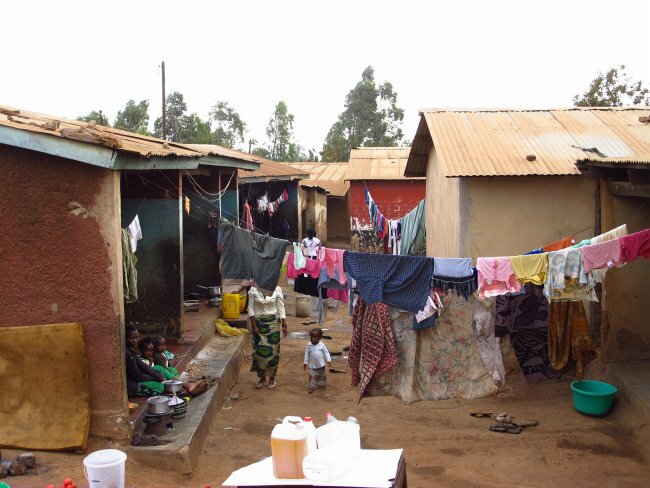
Besides employment, very few resettled communities could adequately provide other social amenities. They lacked schools for children, entertainment sites for youth, markets for homemakers, parks and other communal spaces for the elderly. Many groups of families ended up leaving these "better" homes to come back and illegally rebuild informal settlements in crowded districts of HCMC.
 Starting in 2014: Resettlement Redefined
Multiple reports, articles, and even television broadcasts have made it clear that resettlement projects focusing solely on housing are a failed solution for informal communities. A better house alone brings no better livelihood. "Integrated resettlement," which cares about surrounding facilities and amenities needed for a better standard of living, has recently starting coming up more frequently in recent years.
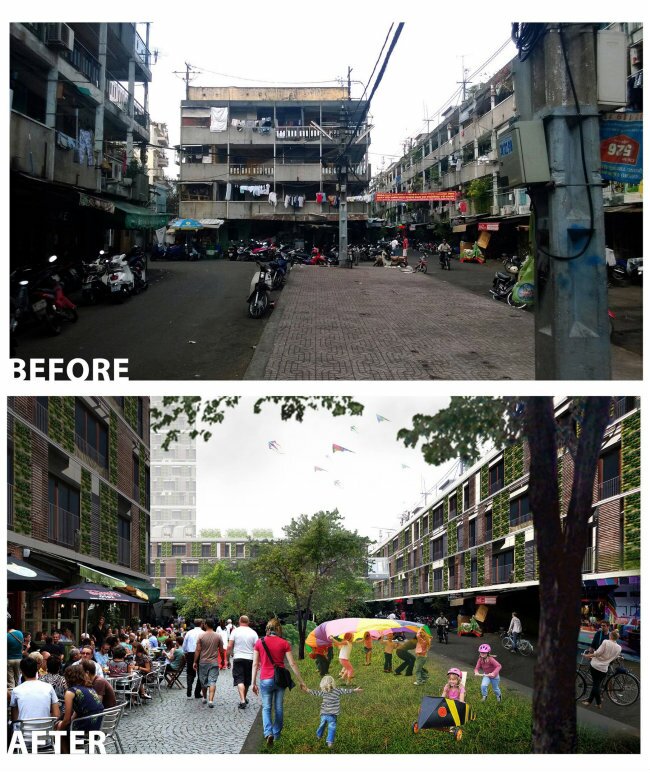
A number of integrated solutions have recently been proposed. One is same-place resettlement, where families would be supported to find temporary houses until their old informal communities are rebuilt into better housing. The on-going Saigon Makeover Competition, organized by Global Shapers of World Economic Forum with support from the government, is indeed seeing many creative same-place resettlement proposals for slum communities (photo 1 & 2). Another solution encourages more complete social facilities in each housing contract, emphasizing the short-term cost for a longer-term attraction for well-integrated communities.
Suggested solutions are promising, but new and few in number. However, with the problem redefined, hopefully the next steps to address these challenges will be faster and stronger. Close.
Photo 1: "Revive a city"s corner," Saigon Makeover Competition - Authors: Nguyễn Ngọc Quỳnh Thy, Đỗ Kim Chung, Phan Xuân Thiện. Photo 2: "Saigon Playing," Saigon Makeover Competition - Authors: DNK Studio" Vũ Xuân Dự, Thân Minh Nhật và Lưu Hoàng Kiếm.
Permalink to this discussion: http://urb.im/c1411
Permalink to this post: http://urb.im/ca1411hce

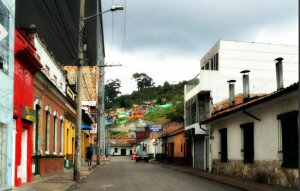 November 2014 — For a city to become more inclusive of its marginalized residents, it needs a proactive land policy that takes into account its unique historical and geospatial contexts, and fits into a broader urban planning vision. A city's laws on land ownership can make the difference between evictions and legal residency; land taxation policies may determine the quantity and quality of real-estate investments, as well as the diversity of residents.
 "I wish Joburg was New York": 'Sweeping' poverty in Johannesburg
 The City's action ended it in two court cases involving the three main associations of traders (SANTRA, SAITF and One Voice), supported by SERI, labour federation Cosatu and law firm Routledge Modise's pro bono associate Michal Johnson. Academic support also came from CUBES at the University of the Witwatersrand. Eventually, the Constitutional Court would lambast the City's "flagrant disregard of informal traders' rights."
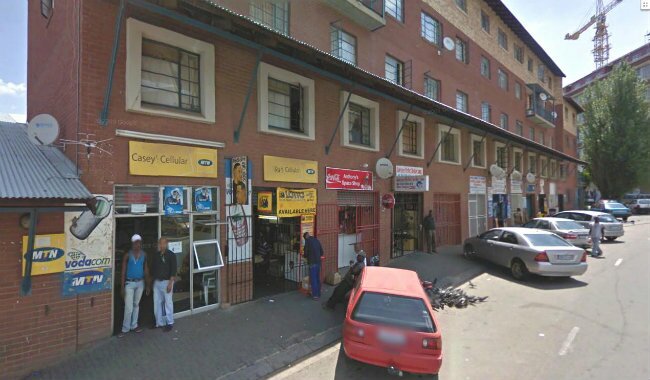 The privileging of the formal economy and repression of the informal economy has a long history in South Africa. Today, private-sector regeneration / gentrification, the City's failure to provide sufficient low-income urban accommodation, while preventing the same people from earning a livelihood on its streets, together make for a powerful exclusionary paradigm. In an urban setting never made to facilitate informal livelihoods, the status quo is thus wholly inadequate. Rather, urban space itself must be restructured, in addition to policy transformation. A more inclusive paradigm would include developing low-income rental accommodation that enables live-work or other economic opportunities (fig. 2), as well as pedestrianization of streets to allow for street trading. A longer term plan could transform the largely defunct railway infrastructure that runs through the inner-city into a public open space system, which could dramatically increase informal economic opportunity (fig. 3: a railway-to-park 2009 City competition proposal).
 There are also much larger issues at stake: about what a democracy and a city is, and for whom it is. For contemporary cities constantly in change, and South African cities recovering from historic injustices, Johannesburg should be less concerned with misplaced modernistic notions about what it wants to look like ("World Class" or otherwise), and more with its role in securing the ethical foundations upon which anonymous city actors collectively shape city form.
 MRT dan imbas terhadap sektor informal
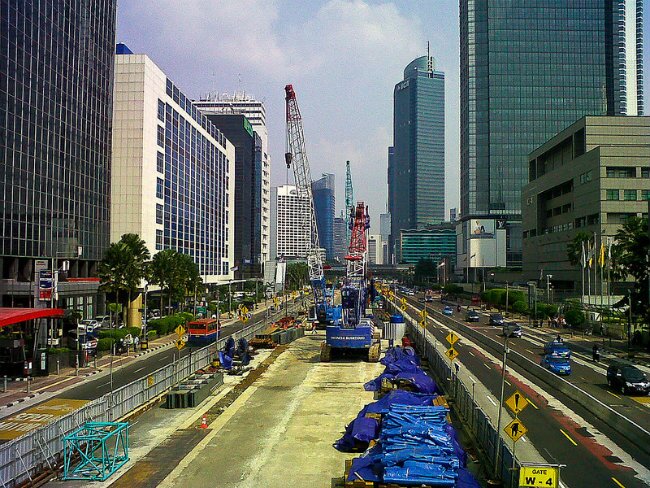 MRT (Mass Rapid Transit) Jakarta rencananya akan dibangun sepanjang kurang lebih 110 km yang terdiri atas Koridor Lebak Bulus – Kampung Bandan sepanjang kurang lebih 23,8 km dan koridor timur – barat sepanjang 87 km. Pada tahap awal, yang akan dibangun terlebih dahulu adalah jalur yang menghubungkan Lebak Bulus sampai Bundaran HI sepanjang 15.7 km dengan 13 stasiun yang rencananya akan mulai beroperasi tahun 2018. Pembangunan MRT merupakan rencana yang kontroversial dan telah tertunda lama. Sejak 2013, tahap awal telah mulai dilaksanakan. Pembangunan tahap awal ini bukannya tanpa menyisakan permasalahan terkait keberadaan pedagang kaki lima (PKL) yang kebanyakan menolak keberadaan MRT ini sebab membahayakan mata pencaharian mereka. Terdapat ratusan PKL yang terancam kehilangan pekerjaan melakukan unjuk rasa menuntut penyelesaian.
 Hasta qué punto la política pública del Bando 2 afectó la inclusión urbana y la informalidad en el DF entre 2000-2006
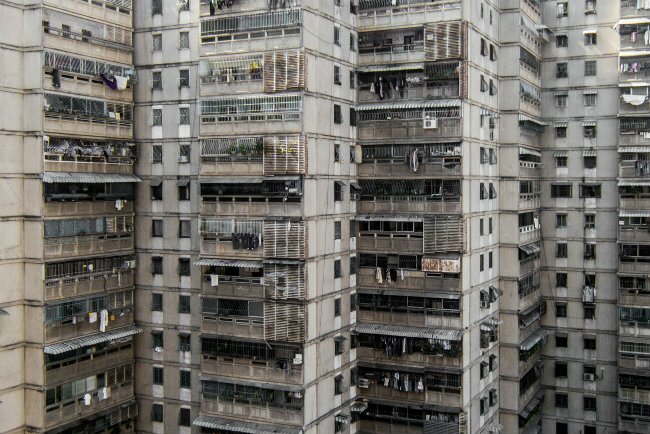 El objetivo del Bando 2 fue convertirse en "un instrumento de la política de desarrollo urbano que pretendió revertir el crecimiento desordenado de la ciudad, la expansión urbana y el despoblamiento de las áreas centrales; preservar el suelo con valor ecológico; y facilitar el acceso de vivienda a la población pobre en las delegaciones centrales."
 Returning Bangalore to its reign as India's "Green City"
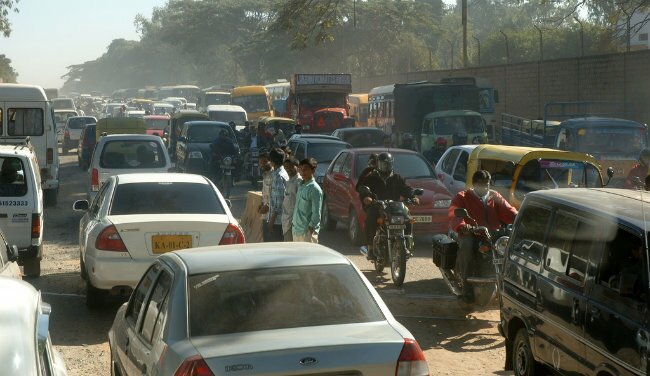 Developing denser, more walkable cities around transit lines — what experts today call Transit-Oriented Development (TOD) — is not a new concept. "In the pre-automobile age, that's how cities developed," says Robert Cervero, a UC Berkeley professor of city and regional planning. "They were compact and had a mix of land uses that were physically oriented to transit because there was no other way to get around." This is a concept Bangalore could adopt as the focus for the next Master Plan. It's an idea that could benefit both residents and administrative coffers.
 La Planeación como forma de combatir el crecimiento informal en las laderas de Cali
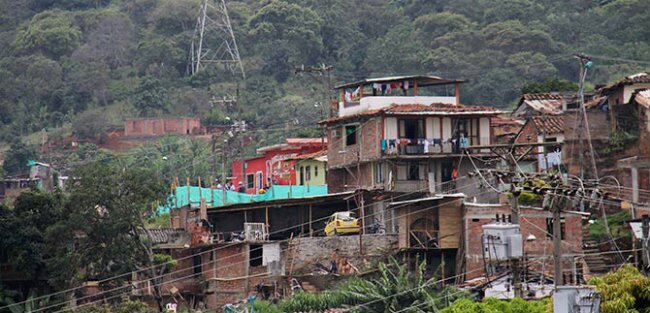 Hasta ahora, la construcción en las laderas estaba prohibida. Sin embargo, la realidad es que unas 400 hectáreas de las mismas se han visto ocupadas por unas 36 000 viviendas informales, en las que habitan unas 160.000 personas, la mayoría de las cuales son desplazados por causa de los conflictos armados. Muchos de los habitantes pagaron por sus terrenos, que fueron comprados a precios muy bajos por la prohibición de edificar, y que fueron revendidos a precios mucho mas elevados a los ocupantes informales.
 A life of dignity through land reforms
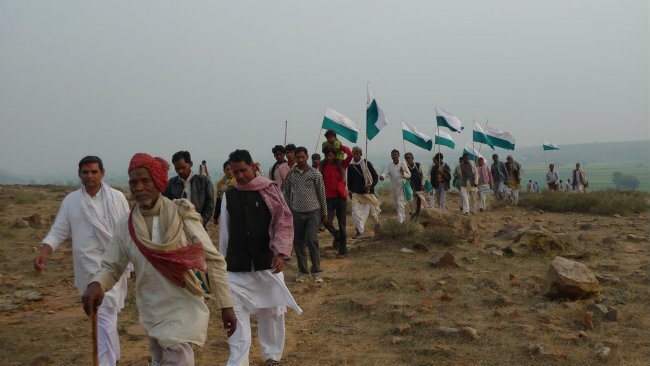 The demolitions happen in two cases: (1) when the land is occupied by slum dwellers without legal entitlements and is centrally located and strategic from real estate point of view; (2) when structures come in the 'right of way' while implementing infrastructure projects. With the growing clout of real estate and mega city projects including 1,483 km long Delhi Mumbai Industrial Corridor and Special Economic Zones, Delhi confronts the above situation with some glaring loopholes. Government of Delhi has been adopting a three-pronged strategy. Concurrent to evictions and demolitions, in-situ up-gradation, relocation of slum structures at far places, and environment improvement of existing 'authorized' or 'unauthorized’ slums are these main approaches.
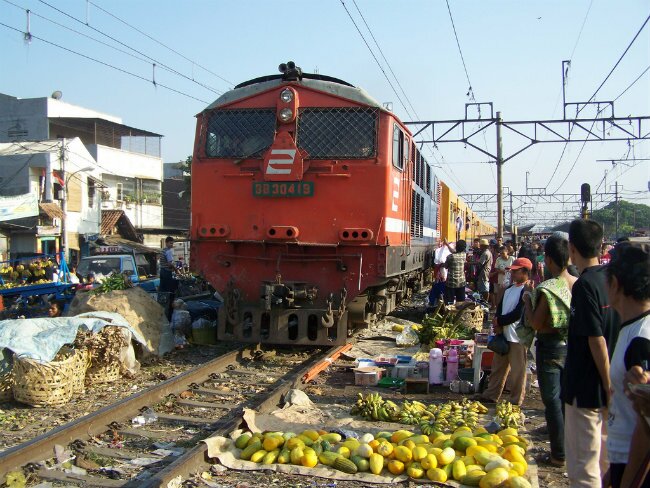 Dalam rangka pembenahan kota Surabaya, maka PT. Kereta Api Indonesia mulai bergerak merapikan bangunan liar di sekitar jalur-jalur kereta api yang selama ini dimanfaatkan oleh pendatang untuk membangun rumah maupun berdagang. Banyak kios pedagang kaki lima (PKL) yang digusur di wilayah Surabaya. Bangunan ini dibongkar sebab tidak sesuai aturan ruang manfaat jalan kereta api yang mensyaratkan jarak antara as rel kereta dengan bangunan di kanan kirinya haruslah berjarak 6 meter. Selama ini banyak bangunan liar dibiarkan sebab rata-rata pedagang membayar uang keamanan kepada oknum tertentu.
 A revisão do zoneamento e a informalidade de luxo em São Paulo
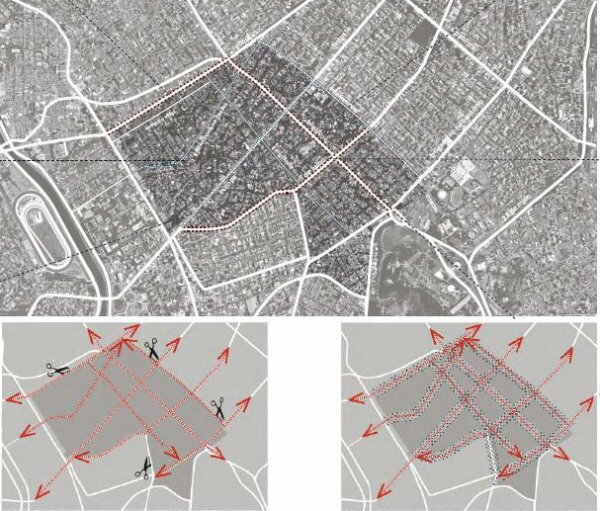 Apesar de regular e definir zonas específicas para usos e coeficientes de aproveitamento específicos, com o objetivo de induzir maiores densidades, a lei de zoneamento foi vista historicamente como uma forma de proteção de áreas bem localizadas e privilegiadas do avanço do desenvolvimento imobiliário. Classificadas como exclusivamente residenciais e parceladas no início do século XX, os Jardins e Bairros da Cia. City, que fazem referência ao conceito de Cidade Jardim elaborado por Hebenezer Howard em finais do século XIX, são exemplos disso. Devido ao caráter especial do desenho do seu loteamento, se comparadas ao restante da cidade, a forma urbana desses bairros foi tombada. O luxuoso e bem localizado Jardim Europa é o mais famoso caso.
 Gendering development planning to address persistent quality of life challenges
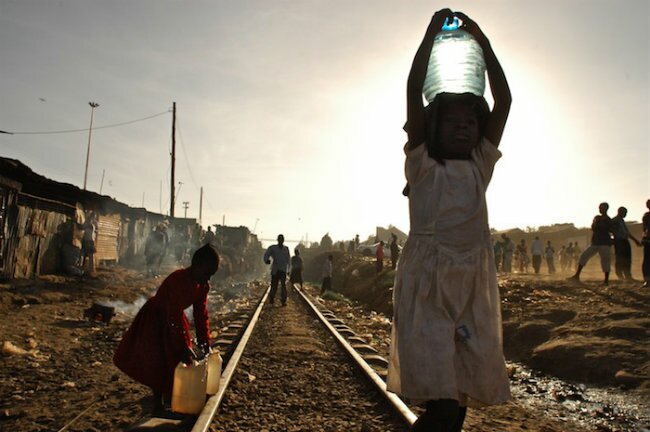 The gendered impact of inaccessible hygiene facilities and affordable clean water in densely populated urban settings has direct impacts on overall public and environmental health. As Sydney Gray, leader of the organization Mama Mmaji, points out, "water is a women's issue." Women slum dwellers face both socially constructed and economic barriers in their ability to secure housing contracts, negotiate fair prices for clean water, and access improved sanitation facilities. They are five times more likely to be unemployed than their male neighbors and live in a context where a nighttime trip to the bathroom is a significant risk marker for rape.
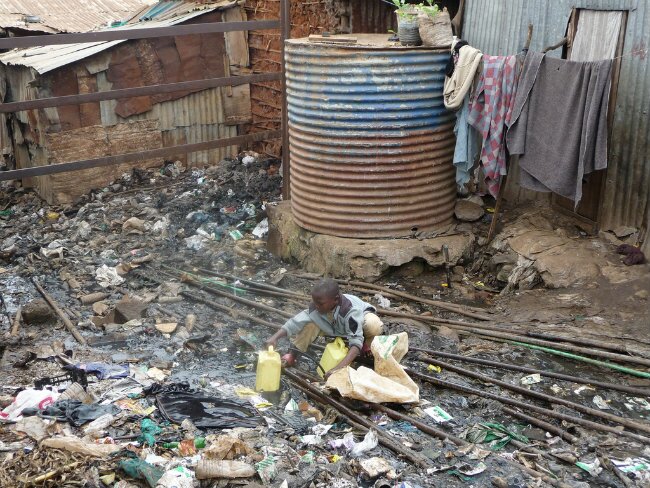 In Kiberia, the Wise Women microfinance collective developed a community approach for building sustainable water and bathroom facilities for residents. With funding from the Kenya Water for Health Organization, and underground metal piping from Nairobi City Water and Utility Company. The collective has succeeded in building a sustainable alternative to the jerry can supplying water cartels while also providing small-business opportunities to a landless class of Kenyans.

 Securing a right to city space
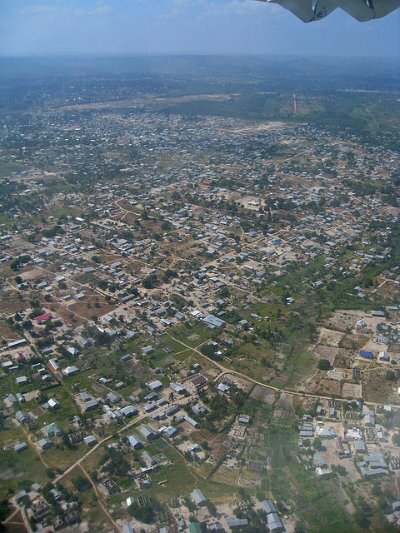 Within Tanzania's land policy, a feminist perspective is key. Women's power over land has historically remained ruled by customary practices whereby a man connects, and enables, a woman's access to land. Further, women's inferior access has left them vulnerable to discrimination with regard to land use and rights. Women have been unable to control their power over land, or what land as an asset entails.
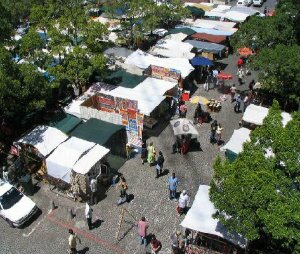 But these openings had other consequences. As South African cities became open to all, central business districts (CBDs) fell victim to urban decay as those who feared the process of integration left these areas. Today these CBDs have embarked on various urban regeneration models centered in the neo-liberal school of thought, to attract formal business back. In Cape Town CBD this has left informal traders in a strange reality: although accommodated and relatively affluent in the country's most attractive and tourist-friendly CBD, their numbers and permitted places of trade are highly restricted: of the major metros, Cape Town CBD contains the fewest number of traders but the lengthiest street trading by-laws (fig. 1).
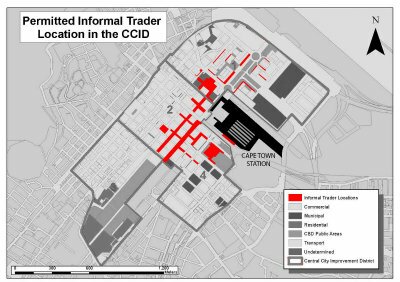 Along with policy, another crucial dimension that must be addressed is the spatial dimension. Location is crucial to the success of informal trading. The Spatial Development Framework, the policy that addresses space on a provincial level, affirms that the spatial structure of urban areas needs to be altered in order to successfully integrate small enterprises into the urban fabric of cities. In Cape Town CBD, permitted street trading is clustered in the essential core areas around the Cape Town Station precinct, whose heavy pedestrian and vehicular flows are ideal (fig. 2). Developments related to the station precinct are therefore critical to opening the CBD up to the informal economy. However, a 2012 upgrade of the station focused on an aesthetic "facelift" without altering the status quo for informal economic practices; and a R80 billion ($8bn) 2010 precinct proposal, which entailed sinking underground the existing railway lines into the CBD in order to open up some 50 hectares of land to new development, similarly shows little evidence of prioritising and restructuring the city to integrate the informal economic practices of the city's poorest (fig. 3).
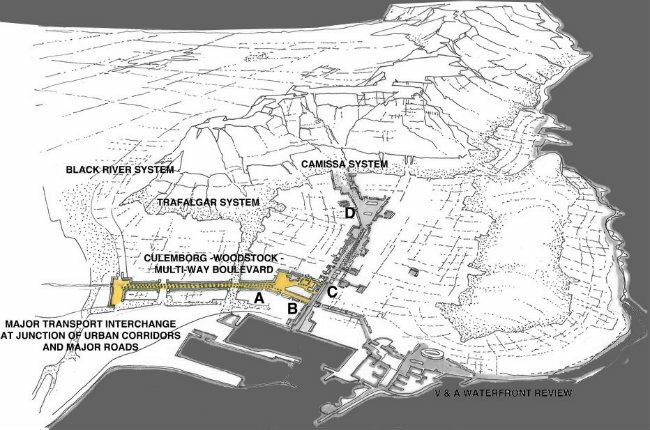
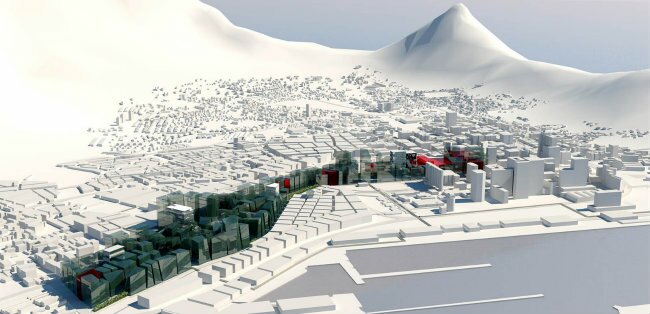 If a new policy direction is to be taken seriously, the City then could revisit Louw and Dewar's intelligent — though apparently abandoned — decade-old proposal which recommended terminating the rail system outside the CBD and building a major new interchange there. This interchange would be linked back into the CBD with a "magnificent" linear public space with an inner city public transportation system, "creating maximum opportunities for small businesses, which are vital to the future of the city" (fig. 4).
 In sum, new policy must energetically be supported by political will and implemented into urban space with imagination to bring about significant change. Informality must finally return from exile. The formal must be informalized, not only the reverse.
 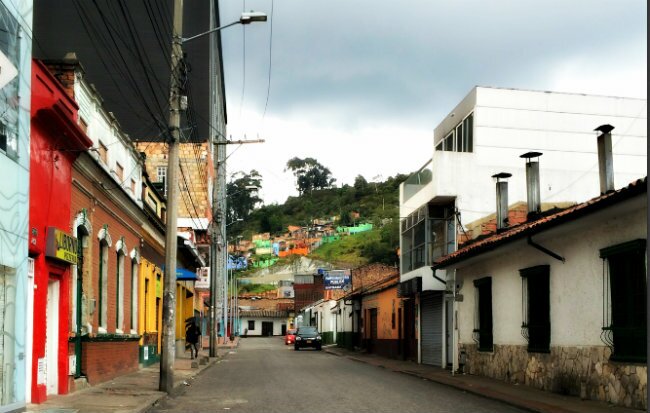 Tal ha sido el caso en el crecimiento observado en algunas zonas periféricas del centro histórico de Bogotá, como la zona de Fenicia. Su crecimiento fue en gran medida informal y se fue consolidando con el transcurso de los años. Sus habitantes, unas 480 familias, ocupan casas pequeñas, y en ocasiones ya se trata de la tercera generación. Sin embargo, el entorno ha sufrido una transformación profunda en los últimos años. Por un lado el crecimiento de la Universidad de los Andes, una de las mayores de Bogotá, y de otros centros de educación superior, ha supuesto un cambio considerable, y por otro los esfuerzos en marcha por recuperar lo que se ha venido a llamar el centro histórico extendido han cambiado la percepción de la zona.
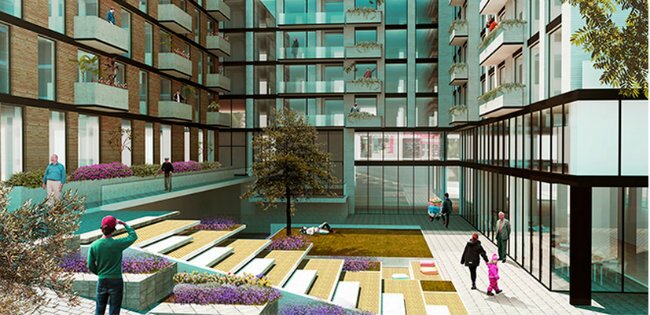 Este proyecto ha encontrado eco en los esfuerzos que está realizando la Alcaldía de Bogotá por revitalizar el centro, y que no se limitan a las zonas coloniales, sino que se amplían a lo que se ha denominado como centro expandido. El proyecto de Fenicia encajaría dentro de este ámbito geográfico.
 Regularisation of land titles: Who benefits?
 While these policies exist to ensure land and tenancy security, the reality is very different. There were reports of numerous fraudulent claims during the initial waves of regularisation, leading to rare enforcement and issuance of certificates of occupancy. To solve the problem of fraudulent claims, in 2012 the Lagos State government came up with the Land Use Act Title Documentation Regulation, made in accordance with the provisions of the Land Use Act. The regulations provided an opportunity for pre-Land Use Act landowners without formal land title documents to obtain the governor's consent and, therefore, certificates of ownership. Prior to this, those without land/documentary titles could not be issued a certificate of occupancy. Other initiatives include making land tax payment electronic in order to make payment easier and to document land use and occupancy.
 Seventy-six percent invisible
 In large part, the reason so few of Lilongwe's residents have been able to obtain access to formal land and adequate housing is due to the city's strong annual growth rate, estimated at over four percent. As elsewhere in Sub-Saharan Africa, this has been 'jobless growth' in the sense that urbanisation has not been accompanied by commensurate industrialisation bringing employment and prosperity. Simultaneously, institutions entrusted with the responsibility to provide public services have been slow and lacked resources in responding to the city's growth.
 The reasons for the project's failure are systemic; the City Council lacks the appropriate institutional structures to address urban development. This has not gone unnoticed: the 2010 Study on Urban Development Master Plan for Lilongwe prepared by JICA notes how a key problem in Lilongwe is the "insufficient level of urban planning and development management administered by the relevant authorities, particularly the Lilongwe City Council." Indeed, since the Gates Foundation debacle, there have been no formal upgrading efforts in the city.
 Formalización de lo informal a través de titularización de tierras
 La titularización de tierras se ha llevado a cabo en otros sectores informales de Caracas en la última década en los municipios de Chacao, Baruta y Libertador. En 2003, se entregaron más de un centenar de títulos a habitantes en un pequeño asentamiento informal en el Municipio de Chacao. La administración tuvo como objetivo ayudar a estas familias a tener acceso a los préstamos bancarios y comenzar su propio negocio o mejorar sus condiciones de casa. Después de una década, las casas se han mejorado convirtiendo estos sectores un paisaje urbano más agradable. Sin embargo pocas personas han hipotecado sus casas para iniciar su propio negocio. En 2006, el gobierno nacional creó la "Ley Especial para la regularización integral de la tenencia de la tierra para los Asentamientos Urbanos Populares", que tiene como objetivo colaborar con los gobiernos municipales.
 El impacto positivo de esta iniciativa puede escalar hacia arriba y no sólo ayudar a los individuos, sino también jugar un papel importante en la reurbanización de las partes olvidadas de la ciudad. En términos de impacto individual, como Hernando de Soto promulga en su libro "El Misterio del Capital", por tener títulos de propiedad de los ciudadanos más pobres puedan tener acceso a los préstamos bancarios, sus hijos pueden heredar de su casa y aumentar su valor de Mercado.
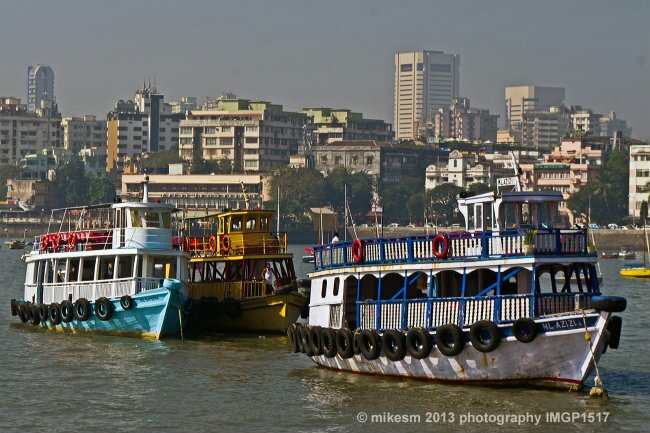 Activists are calling for more such public spaces along the coastline, but the valuable waterfront land has the potential to be gobbled up by enterprising developers eager to build luxury towers and malls. "The absence of a master plan for development of the waterfronts has encouraged the rich and the powerful to manipulate and grab land along the coast, thus gradually depleting the city of its most vital open spaces," writes P.K. Das, a Mumbai architect who has led the recapturing of the western coastline. The city learned this lesson when the former mill lands in a central area of the city, which prominent city architects, planners, and social activists argued should be made into affordable housing and public spaces, were sold off to developers. Now, the area is dotted with malls that house Gucci and Donna Karan, five-star hotels, and luxury office and residential towers. The loss to the city, particularly the poor, is one many still mourn.
Comments
Land titles leading to gentrification?
Hi Ana,
Interesting development that you've covered in Caracas. You outline some of the risks associated with land titling in informal areas, but I wonder if gentrification is one that is also experienced in Caracas? In many cases globally where informal land has been titled this has encouraged the 'original' residents to sell their land following formalisation leading to gentrification of these areas while the 'original' residents sometimes move to other informal areas. One way to control for this has been to bar recipients of land titles from selling their plots within a certain amount of time following receipt of the land title. Other options are for the government to secure tenure but not actually give 'sellable' land titles for X amount of years. There are also ways other than land titles to secure tenure in informal settlements, depending on the layout and living standards in a settlement (a la the tenure security continuum). Do these issues feature in the discourse in Caracas?
Drawbacks from inadequate consideration to policy process
Interesting points you raise Nora,regarding controls and it is clear from all the situation of the various cities, that process of securing titles and tenancy is a very important factor from informal to formal. Similar controls are being implemented in Lagos for the new housing projects limiting the number of times ownership can be transferred and period of time before it can be transferred, the hope is this is implemented properly and due process followed.
As this week's topic has shown it is not enough for policy to be in place, the implementation process affects whether or not there will be drawbacks such as gentrification you and Jorge pointed out and the sustainability of the policy. Also, as seen from Dar es Salaam, Ho chi minh , Lagos and others lack of attention to process can affect implementation in various ways be it reluctance to begin/complete the process as in Lagos due to cumbersome nature, or lack of adequate provision and attention to the multifaceted nature of resettlement which creates new set of urban issues. Creating a good policy requires stable and widely encompasing processes so urban planning is less reactionary and more proactive.
Urban Commons for Neighbourhoods That Work
Hi Olatawura Lapido-Ajayi
I think you & I might be on the same wave length.
I believe "titling" of land leads to wealth for some and poverty for others who get marginalised.
Titling also prepares land for capture by the elite when the desperate poor must sell.
If we are looking at land reform, we don't really need to worry too much about the group who will become owners - they can look after themselves - but we do need to wory about those who are negatively effected by this system of ownership of that which is actually a birthright ALL should have GUARANTEED secure access to - as to air! If we don't guarantee that, life itself is conditional on this ownership system - what does that make of human rights?!
Land reform must begin with guaranteeing human rights - the only ones whose rights are threatened are those who cannot buy their access to the elements for life - the free gifts of nature for life.
With technological job redundancy & global competition, this is a group that is destined to grow, in spite of economic growth.
I would like to see urban commons established in every neighbourhood for eligible people to establish secure housing and community (non commercial) food gardens. Their presence in neighbourhoods everywhere would be an attractive presence which would vitalise gentrifying but lifeless dormitory suburbs.
With such urban commons there would be no need to worrry about "social inclusion" or lack of paying employment - collaboration & cooperation would thrive and compliment the benefits others create through their engagement with the competitive economy.
For a brief "vision" of how this could lay the building blocks for sustainable development, have a look at http://landrights4all.weebly.com/neighbourhoods-that-work.html
Chris
@landrights4all (Twitter)
Urban Commons
Hi Chris,
Thanks for your insights. I do agree we are on the same wave length, Land in a country of birth should really be a given for everyone like council flats in the UK. In the capital city, FCT, this is available. For some places like Lagos, with its small land mass better regulations and reforms are certainly required. However some intricacies are inevitable in land matters. I looked into the concept of Urban commons, and it is definitely work looking into. Brings to mind how things were done in the old days in villages and if it worked then, its definitely worth a re visit for urban centers. How would one go about implementing this though, it still requires a measure of government regulation and land security? It can be argued this comes with titling/ tenancy agreements.
I believe a similar commune is under way in South Africa, Tariq wrote about it a while back, you should also check out that article.
formal or informal?
Hi Tariq, interesting insight from Cape Town on informalizing the formal.
But what is the city government point of view towards the informal traders? And so far what kind of policy issued to help those in informal economy to enter formal economy. I am asking because as I understand those who are in informal economy do not pay taxes hence many cities encouraged them to work in formal sectors because city government can get revenue from the business. There is also retribution type of revenue, which also applied to informal traders who open their business at government land such as park or parking lot (Indonesia have many like this). Adding to this, can I ask what makes the government shift their focus from a regulatory role to developmental role? This is interesting to me because so far, many Indonesian government only understood to formalize informal business.
Crecimiento formal
Jorge, el proyecto de reconversión en la zona de Fenicia me parece muy atractivo para formalizar a los habitantes de la zona; podrías ahondar sobre los servicios y el costo de estos, es decir, ¿en la zona ya hay servicios públicos para los habitantes? ¿Cómo es que pueden tener acceso a ellos dependiendo del estrato? Saludos
Hola María Fernanda. El
Hola María Fernanda. El sistema de estratos fue ideado como una forma de subsidios cruzados, en la que loe estratos mas altos pagan una tarifa superior cuyo importe se utiliza íntegramente para que los estratos mas bajos tengan unas tarifas subvencionadas. Los estratos no se determinan por los ingresos de cada individuo o de sus unidades familiares, sino a nivel zonal, dependiendo del nivel de servicios y calidad de cada zona individual. Es decir, una manzana puede ser de un estrato, y la siguiente puede ser de un estrato distinto, pero en una manzana todos sus habitantes son del mismo estrato. Todos los habitantes de una zona estrato 1, por ejemplo, tienen de forma automática las tarifas subsidiadas correspondientes a ese estrato, sin tener que solicitarlo
El sistema tiene sus problemas. Entre ellos, que de alguna forma perpetúa la segregación, pues las personas de los estratos 1 y 2 se lo piensan mucho antes de mudarse a zonas de estrato superior, pues el coste de los servicios públicos sube de forma significativa. Ya escribí sobre el tema en URB.IM: http://urb.im/ca130923bts
Government support for upgrading
Hi Tam,
Thanks for an interesting article. The challenges with resettlement that you outline are sadly the norm when it comes to government-driven resettlement. It was interesting to read that there now is at least discussion about on-site upgrading or same-place resettlement. How strongly do you think the government backs this? My question is related to the motivation behind previous resettlements - were the poor really moved to enhance their living conditions, or did the government have ulterior motives, such as getting access to valuable real estate? In Cambodia, the government has orchestrated mass evictions in Phnom Penh to get hold of valuable real estate which is then sold or leased to dubious companies..(see e.g. the Boeung Kak case in central Phnom Penh - http://saveboeungkak.wordpress.com/)
Informality by the rich
Hi Carlin, your article points out at a reality that is very present in Colombia, particularly in Bogotá: informal settlements are not only made by the poor, they are also made by the very rich. In Bogota, the Eastern Hills, a natural reserve with the highest protection levels, are under threat by luxury condominiums. Some of the most expensive apartments in the city, which can cost several million dollars, have been built there. Of course, they more affluent have the resources to eventually give legal appearance to their illegal developments.
Public awareness and higher scrutiny are making this kind of luxury illegal settlements increasingly difficult, but still the risk is there.
Location, Location, Location...
Thanks for all of the great insights into your cities! Tariq, I like your final statement in your article stating the formal need to be informalised. It is not a one way street and in order to achieve urban inclusion questions and changes are required within formal and informal land. The current focus often tends to see the informal as requiring inclusion into the formal system, without questioning the suitability, feasibility, and sustainability. But also additionally, the links between the formal and informal land systems are often not recognised. So it is good to see that Cape Town is making such changes.
Within this complex comes the question of location, location, and location - who gets what piece of land, where, and why? Urban space is competitive and the question of location is defined by geographical inequalities (concerning economics, race, etc). Therefore I am wondering within the question of location and including the informal what stakeholders play a key role and require engagement? Governments, but also businesses and corporates are increasingly controlling city space. Therefore in discussing city space and (in)formalisation policy needs a platform whereby such groups can be engaged.
Dignity & Land Reforms
Priyanka, I thoroughly enjoyed reading your article on forced resettlement and human rights issues in Delhi. This is an issue faced by many Nairobi residents and will likely increase as the country continues to develop. I was inspired by the grassroots citizen agency approach you highlighted and believe there is a great deal that can be learned from these efforts. In all major cities globally, it is the poor who are often relocated. We call it gentrification and urban development, but in the end it is the forced relocation of families to meet the needs of industrialization. I agree with you completely that a more human-centered approach needs to be incorporated in this design.
Add new comment