Los recicladores en Bogotá: luchando por el reconocimiento legal
 Bogotá, 14 julio 2016 — Los recicladores juegan un papel crucial, tanto desde el punto de vista económico como medio ambiental. Sin embargo, su labor ha sido siempre infravalorada, y se les ha privado de los derechos laborales más básicos. La Asociación de Recicladores de Bogotá ha liderado una serie de batalles legales y políticas que ha logrado cambiar esta situación. Leer más.
Recyclers in Bogota fighting for legal recognition
Bogotá, 14 July 2016 — Recyclers play key economic and environmental roles. Nevertheless the value of their work has historically not been recognized, and they have been deprived of basic labour rights. The Asociación de Recicladores de Bogotá has led a series of legal and political battles that have brought significant positive change to this important subsection of workers. See more.
 Los recicladores en Bogotá: luchando por el reconocimiento legal
Jorge Bela, Gestor Comunitario de Bogotá
Bogotá, 14 julio 2016
Cada noche, poco después de la caída del sol, es fácil ver por las calles de Bogotá un elevado número de personas dedicadas al reciclaje de residuos sólidos. Realizan su trabajo en silencio, separando los materiales de la basura, y sin interferir en el transitar de los peatones. Aunque el número exacto de recicladores es difícil de concretar, la Asociación de Recicladores de Bogotá afirma que son unos 21.000, un 31% de los cuales son mujeres. Según datos del banco Mundial, citados por la ARB, un 1% de la capital de Colombia se dedica profesionalmente a este trabajo. Por sus manos pasa una cantidad significativa de las cerca de 6.400 toneladas de basura que genera la mega urbe.
Su papel está cada vez más valorado, pues tiene un impacto medioambiental considerable. Cada año más de 86.000 toneladas de materiales reciclables son apartadas del flujo de desechos para ser reutilizados. Aunque esta cifra es aun relativamente baja, se estima que no llega al 16% de todo el material potencialmente recuperable, si tiene un alcance significativo.
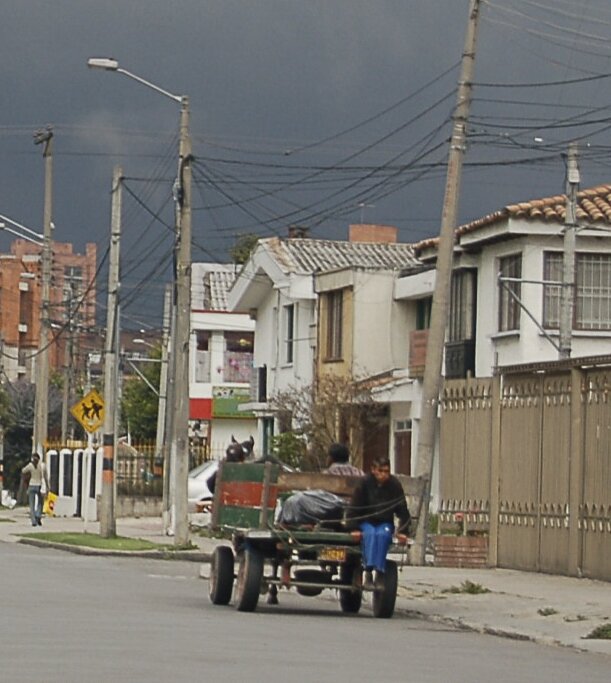
A pesar de su importancia, el trabajo de reciclado ha sido realizado por personas tradicionalmente marginadas socialmente. Con ingresos muy por debajo de los mínimos legales, y sin ninguna protección social. La situación empezó a cambiar tras una sentencia del año 2003, en el que el Tribunal Constitucional colombiano ordenó que se reconociera el trabajo de los recicladores. Sin embargo, como tantas veces sucede en Colombia, las decisiones judiciales no son suficientemente respetadas, y fue necesaria una nueva sentencia, en 2011, para que la administración del entonces alcalde Gustavo Petro, ordenara la integración formal de este colectivo en el esquema de recogida de basuras. El esquema contempla el pago de una cantidad fija según la cantidad de residuos reciclados.
En este proceso fue crucial el papel jugado por la Asociación de Recicladores de Bogotá (ARB) . Fue esta organización, creada en 1991, la que interpuso las acciones judiciales que desembocaron en las sentencias del Tribunal Constitucional. Con cerca de 5.000 afiliados, la ARB es la mayor agrupación de su tipo. Su directora, Nohra Padilla, comenzó a trabajar como recicladora cuando tenía 7 años. Su familia, como tantas otras en su país, había llegado a Bogotá huyendo de la violencia que asolaba las regiones rurales.
La ARB no solo cumple funciones reivindicativas, sino que también imparte formación entre sus integrantes. Ofrece cursos en materias tan diversas como la capacitación en nuevas técnicas y seguridad en el reciclaje, o seminarios de fortalecimiento del liderazgo entre las mujeres. También ha trabajado con organismos multilaterales, como el BID, en la administración de programas de mejoramiento de la situación de los recicladores.
El futuro inmediato sigue lleno de incertidumbre. Por un lado, han surgido acusaciones de corrupción sobre el sistema establecido por la administración anterior. Por otro lado, la nueva administración ha lanzado una propuesta de nuevo modelo de recogida de residuos para Bogotá, que busca privatizar de nuevo el servicio. Aunque en el proyecto queda garantizada la integración formal de los recicladores, la ARB tendrá que trabajar firmemente para que este promesa no quede, una vez más, olvidada una vez que el nuevo modelo sea realmente implementado.Close.
Foto: Jorge Bela
Permalink to this discussion: http://urb.im/c1607
Permalink to this post: http://urb.im/ca1607bts
Recyclers in Bogota fighting for legal recognition
Jorge Bela, Bogotá Community Manager
Bogotá, 14 July 2016
Every night, shortly after sunset, a large number of recyclers start their evening routine. It's very easy to spot them quietly sifting through the piles of urban garbage. Although the exact number of recyclers is difficult to know, the Asociación de Recicladores de Bogotá (ARB) estimates that there are about 21,000 and 31 per cent of them are women. World Bank data, as quoted by the ARB, confirms that overall, the recycling sector adds up to about 1% of the labor force in Bogota. Through their hands passes a large percentage of the 6,400 tons of solid waste that the giant city generates every day.
The role that recyclers play is seen in a much more positive way compared to only a short time ago. Each year, they remove over 86,000 tons of materials from the waste stream in order to prepare them for reuse. This recycling has a tremendously beneficial impact, both economically and environmentally. Still, the percentage of recycled waste is small: some estimates place it at 16% of the total that could potentially be recycled.
Despite its crucial importance, recycling has traditionally been done by socially marginalized individuals. Their income has been well below the legal minimums, and they have enjoyed little or no social protection. In Colombia, a 2003 ruling by the Constitutional Court signaled a change. The ruling ordered that the recyclers work be officially recognized and protected under labor laws. As is so often the case in Colombia, unfortunately, the ruling was largely ignored, and it was not until after a second ruling in 2011 that the administration of then mayor Gustavo Petro decided to formally include recyclers in the municipal waste management system. Under this system recyclers were to be paid a fixed amount for the actual waste recycled.
In these legal victories, the ARB played a crucial role. They filed the legal suits that eventually led to the rulings by the highest court. The ARB has over 5,000 affiliates, which makes it the largest in Colombia. Nohra Padilla, its director, has won international awards for community leadership. She started working as a street recycler when she was 7 years old. Her family, like many other in Colombia, arrived to Bogotá trying to escape violence that was endemic to rural areas.
The ARB doesn't only serve as an advocacy group. It also provides many services to its members. It offers courses on safety and new techniques, as well as in women’s leadership, among many others. It has also collaborated with multilateral organizations, like the IADB, in the management of programs designed to improve the conditions of the recyclers.
The immediate future, however, is full of uncertainty for Bogota’s recyclers. There have been allegations of corruption in the current waste management scheme. Furthermore, the new administration, led by Enrique Peñalosa, has announced the creation of a completely new system, one that's fully privatized. Although the proposed scheme guarantees the formal inclusion of the recyclers, the ARB must remain vigilant in order to make sure that this collective is not once again forgotten once the new system is implemented. Close.
Photo: Jorge Bela
Permalink to this discussion: http://urb.im/c1607
Permalink to this post: http://urb.im/ca1607bts

 Acciones para respirar mejor

 The benefits of community-managed resource approaches
 ILEG has undertaken a Gap Analysis on how to Reduce Emissions from Deforestation and Forest Degradation (REDD) through a conservation and sustainable management approach that nests communities as key agents of stewardship. Deforestation in the Mau Forest region has the potential to increase violent conflicts in the region as this area serves as a catchment basin for the Nile River, and as a result, is a key international water resource with far-reaching implications if managed improperly. As highlighted by ILEG in their REDD+ Gap Analysis, it is critical that the Government of Kenya take seriously the formulation of laws and policies that protect and conserve remaining forests while also working to improve local livelihoods.
 فقر و زلزله در تهران
 Once a jungle, Bangalore’s recycling hub faces rising costs

 Environmental conservation in the City of Trees
 In 1997, the Abuja Environmental Protection Board (AEPB) was created with the objectives of promoting sustainable development, improving environmental quality, conserving and using natural resources sustainably, and minimizing the impact of physical development on the ecosystem. Amongst the various policies being enforced by the AEPB is the ban on tree felling in the city. Violators of this rule are required to pay a heavy fine of 50 000 NGN (USD $250) per tree, and to plant three trees for every tree removed.
 Peningkatan Kesadaran akan Perubahan Iklim