
 Informal settlements: mediators between economic growth and human development
Priyanka Jain, Delhi Community Manager
Delhi, 15 June 2015
In Delhi, when it comes to the typology of informal settlements — notified slums, jhuggi jhompri clusters, urban villages, unauthorized colonies, katras in old Delhi — the list is endless. Owing to the diversity of building forms and extremely complex context, development authorities struggle to impose a uniform set of building bylaws. Proposed institutional tools such as Local Area Planning (LAP), under the Municipal Corporation of Delhi, provide the opportunity to prepare area-specific development controls in close consultation with the community.
 However, as stated in the pilot study on LAP for Delhi (an Indo-USAID FIRE (D) project), the Implementation of LAP raises many questions regarding stakeholder consultation: how can consultants overcome stiff resistance from residents/occupants in carrying out surveys — resistance that arises due to fear of demolition of "illegal/unauthorized" construction? How can they carry out a systematic stakeholder consultation process while preparing the LAP? More importantly, how can consultants raise the awareness of the residents/occupants to engender participation and include the under-represented?
These are the questions that we seek to answer every day at 3x3 Design. After launching a storytelling platform for local cultural organizations to guide creative programming in downtown Rio de Janeiro and strategizing an annual festival to initiate a local consultation process in Dharavi for the "Reinventing Dharavi" competition, among other projects, we've learned a lot about what it takes to realize the principles of a successful stakeholder consultation process. This year 3x3 Design has had the of privilege working with the Delhi Urban Arts Commission (DUAC) team and applying these principles to a redevelopment proposal for Lado Sarai, an urban village in South Delhi. The goal of the proposal is to develop a pilot decentralized water and sewage management system on Old M.B. Road and Shiv Chowk, the oldest part of Lado Sarai.
3x3 Design started a consultation process with the residents through a series of public meetings and workshop events. Over time, while the meetings established trust with the community, the workshop events enabled 3x3 Design to include the under-represented in the process and increase the awareness of the community to garner more voices. For example, the women in the Lado Sarai community were not present in the meetings, either because of family responsibilities or because of cultural norms that limit their mobility. 3x3 Design held a special event — a painting competition — in collaboration with a local NGO-run school named Anurag. Thirty students, young boys and girls aged between 10-14, drew their ideas for Shiv Chowk, including a local community park. The event also provided an environment that was conducive to inviting women from surrounding blocks and provided the opportunity to capture their opinions on the proposal and quality-of-life issues in Lado Sarai.
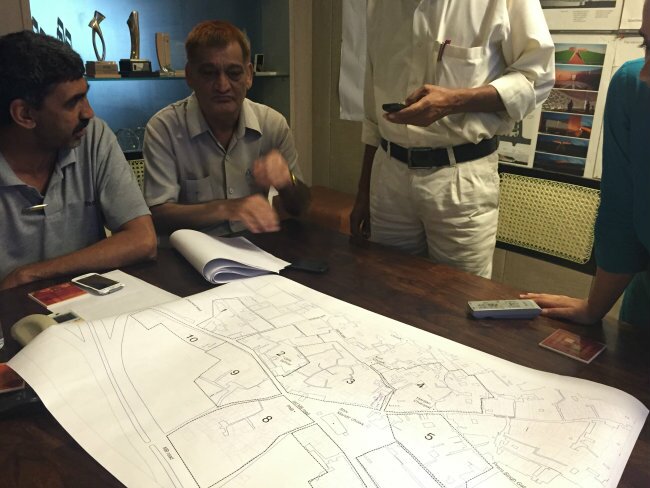
The meetings focused on enhancing the skills of active citizens so that they could conduct the community surveys required for preparatory work. 3x3 Design worked with the community to identify leaders for each block who would provide the key demographic information. With that information and the support of the community leaders, the volunteers and staff did not face stiff resistance from occupants when they went to verify the provided information. It saved a lot of time, effort, and money, and residents have become less hostile and want to know more about the scheme.
The consultation process will continue with the goal of organizing the active residents under a local body and eventually commissioning a development monitoring and evaluation committee from within the community. 3x3 Design believes that consultation processes that seek the community as partners can mediate the relationship between economic growth and human development. These processes hold the key for Delhi to act not just as an engine of growth but also as an agent for greater social justice and environmental sustainability.
Photo: Community members select representatives to conduct demographic survey. Credit: 3x3 Design.
Permalink to this discussion: http://urb.im/c1506
Permalink to this post: http://urb.im/ca1506dle