Blogs

An Urban Sustainable Development Goal. Why? And What?
Next year, the Millennium Development Goals (MDGs), adopted by the United Nations after the Millennium Declaration, are set to expire. The next set of global development goals, which are supposed to be more environmentally focused — the Sustainable Development Goals — are currently under discussion at the UN and elsewhere, including The Nature of Cities. Thomas Elmqvist wrote a piece on the justifications for an explicitly urban SDG; and a group of 12 writers participated in a panel to discuss just what an urban SDG would look like. Read more.

Innovating in an Urbanizing World: Leading From the Middle

Last month, I attended UN Habitat's World Urban Forum, the world's premier gathering on the subject of cities and our urban future. Every two years, stakeholders from across the globe come together at the Forum to examine the most pressing issues facing our rapidly urbanizing world. Over the next three decades, 2 billion people will be added to our planet and most of this growth will take place in cities in developing countries. So, for international development organizations like mine, Global Communities, being able to hear perspectives from the growing number of policy makers, foundations, private companies and city residents that travel to the Forum is an invaluable learning opportunity. Read more.

Facts or Fables: The blurring lines of supernaturalism in the city

When looking at urbanisation within the global south focus quickly shifts to the future. We continue to ask what the city of Johannesburg will envision by 2050; how will Lagos adapt to rising sea levels; and what new urban plans are being made in Dar es Salaam to resolve problems x, y, and z. We frequently assume urbanisation is associated with a shift towards modernisation, and fundamental change. However, progression remains far from linear and the binary distinguishing the 'modern' and 'traditional' has long received criticism. We often forget how the city, like a brain, is formed over time, interconnected through complex paths and senses. The past doesn't simply disappear but forms the core of what cities represent, form, and become. 'Tradition' remains integrated into the life and soul of cities today. One such articulation is reflected through the power of witchcraft in the developing world. Read more.

As barreiras para participação colaborativa na cidade

As barreiras para participação colaborativa na cidade

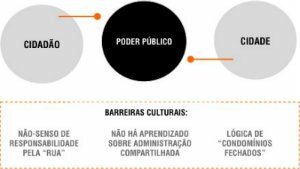
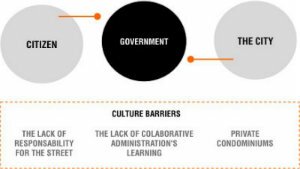
Em meu projeto de pesquisa para o Mestrado, investiguei a relação do brasileiro (mais especificamente do paulistano) com cidade – o que pode instigar ou afastá-lo para uma ação ativa e colaborativa com o espaço urbano. No estudo, foi possível identificar três barreiras culturais que afastam o cidadão brasileiro das questões da cidade. Leia mais.

Es la economía, estúpido (I)

Para esta entrada, decidí hacerle honor a aquella frase acuñada por el coordinador de la campaña presidencial, de William Clinton, James Carville. Dicha frase, surgió dentro de un ambiente donde el entonces presidente George H. W. Bush contaba con un nivel de aceptación muy importante (cercano al 90%), pero la economía estadunidense se encontraba en recesión. Situación muy similar, para algunos, a la que se vive hoy en el país: tensión política, elecciones federales en puerta (2015), y la economía que no avanza a la velocidad deseada y necesaria. Leer más.

Social spaces for social cities

One of the re-emerging questions in urban policy and development concerns whether a 'social' city can be designed, and more importantly what that will look and feel like. Academics have provided a strong basis for understanding the cities social life – questioning what the city is and what it functions to do, to conceptualise the cities' sociability. Within this blog post I would like to synthesise such theories, and secondly, introduce Tanzania House of Hope, a local NGO reviving community capacity within our contemporary age. I would like this blog post to encourage ideas and projects to be shared and supported, but also for us, urbanists, to start changing our view of cities, urban life, and sociabilities. Read more.

Rental markets – A new housing solution?

Discussion on urbanisation across the Global South is often synthesised with images of slums and the growing problem of informal housing. There is a housing crisis in urban Africa, and research is focusing on understanding where urban dwellers dwell. Estimates suggest around 70 percent of urban Africa live in slums; an increasing, invisible homeless population, and limited land governance – with only 85 land surveyors practicing in Kenya. Within such statistics are a rising number of urban renters. The rental market remains an important source of habitation, however, has been given minimal attention within development policy and practice as the discourse focuses on ownership. Read more.

Desafío titánico: La educación de nuestro país

Desde que comenzó la actual administración, el presidente de la República comentó que se llevaría a cabo un censo educativo el cual se encargaría de brindarnos información relevante en el tema: alumnos, maestros, infraestructura, montos financieros, entre otras cosas. Como bien dicen, "lo que no se puede medir, no se puede evaluar; lo que no se puede evaluar, no se puede mejorar". Leer más.

Un México de aspiraciones grandes, pero de políticas públicas cortas (I)

En el blog pasado, había comentado que proseguiría con los resultados que mostró la Consultora Mckinsey (cosa que realizaré posteriormente); no obstante, considero importante el comentar la encuesta realizada por el Instituto Nacional de Estadística y Geografía (INEGI) y el Instituto Mexicano del Seguro Social (IMSS) denominada Encuesta Nacional de Empleo y Seguridad Social (ENESS) 2013. Leer más.

Pages

Subscribe to RSS - blogs