
Micro-finance and investment
 Micro-finance — the provision of credit and other financial services to micro-entrepreneurs and small businesses that lack access to mainstream banking — has proven to be a remarkably effective way to reduce poverty in cities across the developing world. The principle is simple: through access to credit and related resources, the urban poor are empowered to pull themselves out of poverty. Still, as with all matters of finance and investment, the details matter — especially since the goals of justice and financial inclusion have been so elusive in the past. Read on to learn about micro-finance solutions from Dhaka, Mumbai, Cairo, São Paulo, and Bogotá, and then join the discussion below.

|

|

|
|

|

|
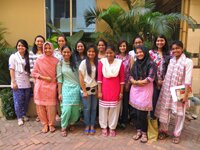 Grameen Bank, a bank for the poor
The Asian University for Women Writing Team, Dhaka Community Managers
Grameen Bank is one of the most successful experiments in extending credit to Bangladesh's poor. Many have used microfinance to pull themselves out of poverty. The beginnings of Grameen Bank can be traced back to 1976, when Professor Muhammad Yunus, the head of the Rural Economics Program at the University of Chittagong, launched a research project to examine the possibility of designing a credit delivery system to provide banking services for the rural poor. This research project grew, and as of 2011, Grameen Bank's 23,144 employees serve 8.349 million borrowers (97 percent of which are women) in 81,379 villages, covering more than 97 percent of the total villages in Bangladesh. Borrowers own 90 percent of the bank's shares, while the remaining 10 percent is owned by the government.
 The Grameen Bank's loan system is divided into several steps. The first step is to encourage the poor to believe that they can succeed as an entrepreneur. The poor attend a training program, and then draft a credit proposal. Only then do the beneficiaries receive the funds for investment. The rest of the process includes fund collection, returns, operations, and credit cost.
Grameen's methodology encourages borrowers to strive for specific goals in social, educational, and health sectors, known as the "sixteen decisions". These include helping others in need, drinking clean water, and educating children. Grameen therefore does not limit itself to providing credit, but also works on other development goals.
Grameen Bank's work shows how transformative a small amount of money can be in breaking the cycle of poverty. Microfinance has shown to be one of the most effective means of "developing from below," leading not only to increased income but also to empowerment.
Photo credit: Schipul
 Small loans in the big city
 While the city is full of formal financial institutions, Shaila is one of millions of urban poor who lack the collateral or documentation to access bank loans. In an effort to fill this gap, Veena Mankar launched Swadhaar as an NGO in 2005 to bring the same microcredit services to urban areas that were taking off in rural India. The pioneering organization became Swadhaar FinServe Pvt. Ltd. in 2008. Swadhaar's clients are nearly all engaged in Mumbai's large informal economy, running micro-businesses such as food stalls, small general stores, and tailoring services.
 Microfinance for inclusive growth
 The Cairo Economic Livelihoods Program (CELP) is one example of a successful microfinance organization that serves Cairo's poor. A joint effort between the Aga Khan Foundation and the Canadian International Development Agency, CELP concentrates its efforts on the residents of Darb el Ahmar, a district characterized by its poverty, as well as its production of oriental crafts like wood inlaying and tent making. CELP provides microcredit for local residents to develop their crafts, and also provides employability services.
 By creating these market linkages and providing business development services in addition to microcredit, FMF has contributed to Cairo's inclusive growth, providing the poor of Darb el Ahmar with a new source of income. Furthermore, CELP runs its own economic program that coordinates both the vocational training programs and job counseling and placement unit. Vocational trainings are designed to teach the skills needed develop a small business, such as carpentry, plumbing and electrical maintenance. The career center offers advice, and connects residents to jobs based on their skills. To date, CELP has ensured new employment opportunities for over 350 individuals, 40 percent of which are women.
 Ampliando o aceso a microcrédito: O caso de São Paulo Confia
 Tendo em conta esta situação e para facilitar maior aceso ao crédito dos novos empreendedores, especialmente aqueles de baixa renda, em 2001 foi estabelecido São Paulo Confia, uma instituição sem fins lucrativos, que foi criada por entidades da sociedade civil e atualmente conta com apoio financeiro e gerencial da Prefeitura. Nos últimos dois anos, a instituição atendeu mais de 20 mil microempreendedores.
 Microfinanzas: Soluciones innovativas en Bogotá





























Follow @urb_im














Recent discussions
Retooling 'Cities for Life': New approaches to urban infrastructure and service provision 03.14.2014
Urban planning and design: Laws, regulations, and the informal city 03.03.2014
Food security in coastal cities 02.17.2014
The competition for water 02.10.2014
Violence against children 02.03.2014
Comments
MFIs to acheive development goals
These articles really show that microfinance has an impact in the lives of the poor in each of our cities, especially on the individual level as Carlin described. It is for this reason that microfinance is studied as one of the most prominent solutions for poverty alleviation in development economics. When we talk about the institutions that sponsor microfinance activities however there is much debate. Is this exploitation of the poor, with interest rates being much higher than in formal financial institutions, or does it finally allow those in need to invest in themselves to better their livelihood?
I would be really interested hear more about the case in Bangladesh. From what I understand the Grameen Bank has partnered with BRAC and other MFIs and has even begun financing infrastructure developments including mobile phone services. The outreach of these institutions in Bangladesh has covered the shortfall of public services in some areas and has definitely had an impact with the country recently achieving its MDG targets.
With the current economic situation in Egypt, microfinance is indeed a solution that can focus on relieving Cairenes from the vulnerability of poverty. How can we help these institutions have an impact on a larger scale using public policy instruments?
More detail on the Grammen Bank's work in Dhaka
I am very interested to learn about the Grameen Bank's activities not in Bangladesh as a country, but specifically what happens in Dhaka. For example, I am curious to know if the Grammen Bank operates differently in the urban areas, and if there are differences in the type of credit given to its beneficiaries depending on its location (rural vs. urban).
In addition, I would like to know how many beneficiaries are there in Dhaka, how many Bank service sites operate within the city, and what are the challenges of the Bank's expansion at the city level.
Training and Support
Swadhaar's program is impressive for many reasons, but I was struck by the fact that it is really reaching out to the poorest of the poor. This is a section of society that microfinance initiatives often miss, because they need so much extra support and are a much higher risk. As Catalina points out, training and education is necessary and this support needs to extend to different areas in order for these programs to really be successful.
One area of microfinance that we really haven't discussed this week is connected to non-income generating needs of the poor, such as household upgrades, water and sanitation needs, and electricity. Microfinance intiatives usually focus on areas where they can see a return, but often don't make the connection that, say, cleaner water will reduce sick days for a family, thereby increasing their monthly income. Selco, an India-based solar power social enterprise that focuses on the poor, wrote for urb.im a few months ago about "An Energy Loan's Ripple Effects." The article notes that "small interventions (for instance, providing solar lighting solutions to replace kerosene lamps for slum dwellers) can lead the poor away from more costly but currently conventional approaches — generating savings, increasing the number of healthy working hours, and lighting the path toward incremental improvements in the lives of slum residents." I'm curious to know if there are the same barriers to microfinance loans for these types of initiatives in other countries and if anyone has seen any interesting programs working to connect microfinance to basic services.
Basic needs and the gam3eya in Cairo
Carlin thanks for bringing up the aspect basic services. Indeed many microfinance institutions don't support investment in these services unless there is a guaranteed return on investment. In Cairo, one of the many ways that the poor secure money for investments in housing and savings is through the "gam3eya." Derived from the root meaning group, the gam3eya is a generally a form of group saving in which each member pays either per week or per month and the sum of the collective group rotates among each member in turn. After each member of the group has received the lump sum once the cycle repeats. Essentially it provides members access to a large amount of capital at no interest.
This practice has been used in Cairo for years, mainly organized by individuals themselves in poorer communities. However some microfinance institutions have begun to assist their clients in creating their own gam3eya to initiate investments in basic services as well as help secure individuals will repay their loans on time. From what I understand though is that these MFIs do not provide the cash in order to make investments with the gam3eya.
Lina replied on Permalink
Microfinance & Urban India
I think the discussion about how, and under what conditions, microfinance works in urban India is an important one, that has so far not been covered extensively in the literature or in the popular press. As the focus has generally been on rural INdia, we don't know as much about how to make microfinance work in urban settings. For instance, one general issue has been the focus of lending agencies of lending to poor women and men to become individual entrepreneurs, however, the loan amount has often been far too small to be used for productive purposes and often ended up filling gaps in household incomes. Since India's central bank capped the upper limit of loans to entrepreneurs, it is more difficult for poor entrepreneurs to access adequate financing for setting up or growing a small business. I wonder if microfinance in urban settings might find these two issues (loan covering household costs, and being too small for productive purposes) even more of a problem given that the cost of living is much higher in cities.
More investigation needed
Lina, you are right--there is very little out there on urban microfinance, and, as you say, the urban landscape offers its own unique challenges. The cost of living--and simply doing--in Mumbai is very high compared to most cities, let alone rural areas, so conditions for loans would have to take this into consideration.
Also, as I mentioned in my other comment, I think it's important to consider the services that might be needed by the urban poor and how microfinance can adapt to being utilized by the poor for basic service needs. Though there are few discussions on urban microfinance, most focus on the entrepreneurial aspect. I'd be interested to see more on other loan uses and how the banks can open up to the other needs of the urban poor that might not show such an obvious return as livelihoods.
Grameen Bank, a bank for the poor
Thank you, Catalina Gomez for your question.
In Bangladesh, most of the poor people live in rural areas and the poverty rate is highest in rural areas with 36 percent. Grameen Bank provides credit to the poorest of the poor in rural Bangladesh, without deposit. The bank has brought a positive change to the rural development in Bangladesh. With 2,565 branches, GB provides services in 81,379 villages, covering more than 97 percent of the total villages in Bangladesh. Almost all of the beneficiaries of Grameen Bank are from rural areas.
Grameen Bank’s head office is located in Mirpur, Dhaka. The head office operates and maintains all of the activities of the sub-offices as well as branches. Grameen Bank branches are located in the rural areas, unlike the branches of conventional banks which try to locate themselves as close as possible to the business districts and urban centers.
Every year, Bangladesh has experienced natural disasters, for example food, cyclone, drought, and so on. During this period, many rural people and coastal areas people lost their wealth and professions and won’t be able to earn money. Therefore, they often face challenges to return installments of Grameen Bank. In the mean time, Grameen’s repayment rate has gone down. To solve this problem, the bank opens a mandatory life insurance policy for every member. So that if anyone faces life threatening problem or lost their whole wealth by natural disaster, the borrower’s installments will be paid from the life insurance.
Greater coverage in urban areas
Saima, thank you so much for your overview regarding the work and challenges of Grameen Bank in Bangladesh. I understand that in your country poverty is highly concentrated in rural areas. Still Dhaka is one of the biggest cities in the world, and due to its size and conditions, it presents a high percentage of poverty as well.
Hopefully in the future there will be greater discussions on how several micro-credit institutions can expand their services in urban areas, where poverty conditions can also be harsh and even some “risk” factors can be greater than in the rural areas (As Carlin mentions in the case of Mumbai, the fact that most urban poor are migrants, adds “risk” to the transactions).
Lorena Medina replied on Permalink
Integral Programs
What impressed me the most of the articles, whether Dhaka or Sao Paulo, was the overlaying sense of community and the financial and social scope of each of the programs described. On one hand, when speaking of micro-finance each program encourages community involvement and cooperation, from Grameen Bank's "sixteen decisions" to Sao Paulo's "solidarity groups". On the other hand, each program also has a broader scope than would be expected from a financial instrument, emphasizing that development is not only about creating or increasing access to loans, but also pursuing greater social goals, including education and employment.
Add new comment