
Work conditions: informality, coercion, and change
 The recent factory collapse in Savar, Bangladesh reminds us that working conditions in the developing world can be unsafe and sometimes even fatal. Workers often face low wages, informal status, and long hours. Conditions are often dirty and unsafe, with uncontained contaminants and dangerous machinery or buildings.
The following reports from our community managers describe attempts to address these issues in Dhaka, Bangalore, Nairobi, Lagos, and Rio de Janeiro. Read on, then join the discussion in the comments below.

|

|

|

|

|
 |
Working conditions in the Bangladeshi apparel industry: grief and hope
Ulfat Jahan, Dhaka Community Manager
Bangladeshi garment factories have become synonymous with deathbeds, as evidenced by the frequent accidents, fires, and building collapses in recent years. The recent building collapse in Savar caused the deaths of thousands of workers. As a consequence, foreign investors are withdrawing their investments from the garments sector, which accounts for 80 percent of the country's export earnings. It is surprising that despite the overwhelming importance of this sector, law enforcement in this sector is depressingly weak.
 How do we explain the negligence towards safety in such a vital sector? One explanation is that 42 percent of the owners of garment factories are in fact lawmakers, and proper enforcement of the safety regulations would reduce their profits. They have little incentive to facilitate the enforcement of these laws. The major buyers, another important group of stakeholders, have taken initiatives such as producing training films and conducting private audits, but these initiatives have made only a small impact. The trainings are ineffective when confronted with real crisis situations, and the private audits have been proved to be futile since some of the factories that had passed these audits experienced major accidents soon after.
The indifference of the lawmakers and the failure of the buyers are frustrating, but there are other actors fighting for workers' rights. Although the Bangladeshi government has been restrictive regarding the formation of trade unions, the National Garment Workers' Federation (NGWF), Bangladesh's largest trade union federation, has been relentlessly working for garment workers' rights for 29 years. Two of its main objectives are to ensure decent working conditions and fair living wages. The NGWF negotiates with the government, factory owners, and multinational corporations for stronger legislation and proper enforcement. Additionally, it provides legal advice to workers and organizes training sessions to create awareness among the workers about their rights. The NGWF drafted the Bangladesh Fire and Building Safety Agreement in 2011 with other labor organizations; it proposes the creation of a team of independent inspectors to ensure safe working environments. However, the major buyers denied the proposal since it requires massive investment. The Savar tragedy has revived the enthusiasm of NGWF's president, Mr. Amin, who has started a petition calling on retailers such as Primark, Matalan, Mango, and Bonmarche to sign the agreement, as these companies had contracts with the factories in the collapsed building. As of May 2013, Primark and H&M had signed the agreement due to popular pressure.
The Bangladesh Center for Workers Solidarity (BCWS) is a non-profit organization that also promotes workers' rights in the apparel industry. In addition to building the workers' capacity to advocate for their rights, BCWS is renowned for the documentation of labor abuses and violations of labor rights. Its leadership training program for female garment workers has successfully educated workers about their rights, and has led to the creation of female-led trade unions in a number of factories.
These organizations' road to success is not easy. It is difficult to attract exhausted and underpaid garment workers to union meetings. More challenging is to influence the government and the buyers, since the interests of these two groups sharply contradict with the workers' interests. In addition, court cases and police repression against members are all too common.
Hopefully, the Bangladesh Fire and Building Safety Agreement will be signed and will be implemented effectively, improving the factories' working conditions. The labor organizations must work together to negotiate with the lawmakers, and should raise support from international consumers as the consumers' collective buying power can significantly impact the retailers.
Photo: Rijans

 Bangalore has 500,000 garment workers — almost 90 percent of whom are women. They work for wages that would take them months to save for the fashionable items they spend long hours making. A Guardian article on the 2012 tribunal says the national textile industry is worth $53 million a year and employs 35 million people across India. "Garment exports are worth £21bn. But human rights campaigners accuse international brands of subcontracting to firms paying poverty wages to the people who make their clothes." In addition, workers at the tribunal spoke out on abuse for not meeting impossible quotas, lack of drinking water and toilets, poor healthcare, and long working hours. Many of the women are sole breadwinners for their households and face hurdles in educating their children on such low wages.
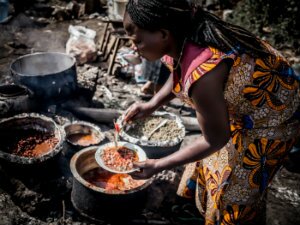
 One such cluster of traders has been operating from an area called Riverside for half a decade. "When we first came here we agreed with the City Council that we could stay," says Mary Wambui, who prepares large quantities of tea, maize meal, and stew over a small wood fire in a series of scorched and battered tin pots. "The agreement was verbal and they never issued us with licenses. Over the years we have been forced to move again and again. Recently the police have really stepped up the pressure: as soon as they move us from one precarious piece of land to another, the cycle of harassment starts again."
 The objective of the group is to petition their constituency representatives into recognizing that they are providing a much-needed service to workmen and commuters alike, and that as such they should be assigned a plot of land from which to operate.
 "This morning the police came and made a swoop," says Wambui. "We had just finished cooking, but now we have no plates on which to serve food. Instead of going to the police station ten kilometers away, we have decided to write a letter, which we will present directly to our councilor. If they want to relocate us it is fine, but now we are a group and as such they must treat us with more respect."
 Earlier this year, the workers of the Chinese factory went on strike, demanding retribution for the family of their deceased co-worker who passed away. They protested against the lack of safety tools, and for better work conditions, fewer working hours, and increased pay. In this factory, employees work long hours and are paid below the stated minimum wage as a contract staff. The Campaign for Democratic Workers Rights (CDWR) has been instrumental in supporting the factory workers' struggle for better employment conditions.
 Reconhecendo estes avanços o principal desafio que o Brasil enfrenta atualmente é aumentar a formalização de trabalhadores que continuam na informalidade. Para colocar uma perspectiva de cidade, observemos a situação no Rio de Janeiro. Segundo a iniciativa cidadã Rio Como Vamos, em 2007 Rio tenha 2,174,568 trabalhadores formais e em 2011, só foram registrados 320 mil trabalhadores a mais, tornando-se urgente maiores esforços na formalização. Os grupos que seriam mais favorecidos com esforços específicos de formalização são os pequenos empreendedores de baixa renda e outros trabalhadores informais com pouca visibilidade tais como os domésticos e catadores de lixo.
Comments
Employee unions: The first step in fighting against dire working
In my opinion, I think there should be relevant unions that can cater to different sectors. Working unions I mean. There so many workers out there who work in hostile environments but can't complain. They tend to cope with the situation in which they find themselves... which is not right. At least if there are unions that every worker from different sectors or organisations can join... it will afford them the opportunity to lay their complaints to the appropriate quarters and I believe the right action will be taken.
Unions
I completely agree with you Feyi, unions are important and provide an outlet grievances and fighting for better working conditions. More importantly is the regulation of said unions otherwise they would be pointless and this is where more attention needs to be placed. In the situations spoken about in the various cities some employees are not even allowed the unions as in the Lagos's case subject if that is not allowed what can the workers do? They need the job for survival and its a battle between need to afford basic needs and enduring a hostile work environment with unfair conditions. unions need to be mandated especially in the blue collar world and informal sectors where contracts often do not exist to protect employees.
Updates
Updates:
1. Bangladesh loses GSP facility in US. Link: http://bdnews24.com/business/2013/06/27/bangladesh-loses-gsp-facility-in-us
2. GSP Crucial for Bangladesh: US Ambassador Mozena. Link: http://bdnews24.com/business/2013/03/28/gsp-crucial-for-bangladesh-mozena
Globalisation as a perpetrator of informal working conditions
When reading the experiences of Dhaka and Bangalore this week, it’s hard not to realise how many worlds away Nairobi is.
As a country, Kenya does not have any large-scale garment industries, if anything one of its main economic sectors is the second-hand resale of the very brands (Primark, Matalan, H&M) that were made by garment workers in the above cities and, after having been worn ten times, were given away to charity. Similar working conditions are however experienced by employees in the industrial sector that specialises in household commodities (soap, toilet paper, tin foil, cellophane wrap, pots, pans etc) for the national market. These employees often live in slums that lay adjacent to the factories and provide a source of cheap labour to the owners who are not required to employ them full time or with a contract. As a result, any attempts on the part of NGOs to cajole factory owners into providing improved working conditions for their workmen have generally gone unheeded because it doesn’t benefit them or their profit margins. So far activism in these slums are constrained to tackling issues regarding land tenure because, as Ulfat mentioned, exhausted and underpaid workers are hard pushed to be able to organise effective trade unions to pressure their owners into respecting their rights.
It is important to remember how few consumer goods for international consumption are produced in Africa. As the Nairobi example demonstrates, what multinational exploitation does exist comes in the form of the infrastructure development which is taking place all over the country and which is on the one hand providing employment to large-scale sections of society but which is at the same time undermining the rights of many hard working people associated to this boom. It’s hard to draw parallels really, informal work tends to be oppressive everywhere and globalisation can be pinpointed as one of the main determinants of demand for cheap labour and hence unfit working conditions. While unions and any form or workers’ associations that battle for their rights are undoubtably necessary, they face an uphill battle when it comes to fighting against large corporations and profit-oriented businessmen who either are the law or have the law in their pockets.
Katy Fentress
URB.IM - Nairobi Community Manager
@whatktdoes
The other side of globalization
Hi Katy, I agree that the abuses of international companies are to blame for some of the very low working conditions affecting millions of workers in various developing countries. But I also think that globalization is actually helping in many ways to change such abusive reality. In a general way, globalization is making people more aware of the insecure conditions for workers and the tragedies related to them. Being able to see such evidence on TV, and being able to follow it on Facebook and Twitter is also putting some pressure in the companies that are taking advantage on the local cheap labor. The fact is that such information can affect their reputation and therefore their sales.
In addition, I think that as a global economic and social problem, adequate labor conditions need to be discussed in international audiences and committees, and in this sense global forums might help to put pressure on countries that don’t support minimum standards. What I still consider is a local “duty” and where most countries need to do their "homework" is in strengthening their own legislations and mechanisms to ensure basic standards are really met. Ulfat in her article from Dhaka explains that many garment factory owners are lawmakers as well, creating a clear conflict of interest and very low incentives for change. This leaves room for international/global pressure to support long lasting change in partnership with related local movements and civil society organizations.
More on globalization
Catalina, I appreciate you bringing up the flip side of globalization, and I'd like to believe that what you are saying is true. To be honest, though, I'm skeptical. Having just gone back to the US for a month following the flurry of articles on the Bangladesh garment collapse, I heard very little buzz around this anymore. It seems that these tragedies make headlines (right now in the US, there are many articles on the 20+ children who died from their school lunches--part of a large-scale midday lunch program--being poisoned; the US stories I've seen are raising awareness around malnourishment of children in India) and then quickly disappear from sight and thought. Does it really influence buying patterns? I have no scientific evidence for this, but from my own personal observations, I don't think that people are buying more consciously, keeping in mind the conditions under which their clothes are potentially being manufactured.
I know this sounds like a pessimistic take, but it seems like the only incidents that make headlines are huge tragedies. Only then does the world take notice, and even then only for a split second. More proactive protective approaches for workers need to take place domestically. I believe in the approaches mentioned in the Bangalore article--grassroots workers' movements and tightening of government regulations. However, given the complex international connections today, you're right to say that we have to think of the solutions more globally. And we all are responsible, even after the headlines go away.
More on globalization
Carlin, I agree with your realistic perspective. The process of change is indeed long and complicated. Unfortunately this is usually what happens when there are diverse actors and interests associated with a particular problem. I still think that change regarding work conditions in various countries won't come from just one side of such complex scenario, but from local initiatives jointly supported by international awareness efforts. And although consumers usually have "bad memory" and aren't interested in the implications of their purchases, I consider that efforts to report and make more visible those companies that aren't following adequate labor standards shouldn't be underestimated. These efforts can put some pressure on the companies and generate greater debate around the need for more accountability and responsibility among employers.
Foreign Direct Investment (FDI)
The experiences of workers in factories of all sort, foreign production plants and factories or at least does that carter to foreign companies is appalling! the stories here have really struck a nerve with me. Imagine working in an unsafe environment that could collapse at any minute, while in some cities lives are not lost yet, it really does not have to get to that extent for intervention. Unions are one thing but really overworked employee do not have the time, underpaid employees may not be able to afford union fees at the end of the day though it is a step in the right direction. What is imperative is for governments to try to monitor these so called foreign investments in their countries. A company restricting union formation or membership of its employees is likely violating Labour laws. The citizens are supposed to benefit from foreign investments in the countries, not just the economy and said firms. Its time to review investments policies and monitoring and evaluation, at least from time to time to see who is abiding the law, might sound like a long stretch but slow and steady wins the race. Workers have died in Lagos and Bangladeshi from unsafe working environments, that at least has to take priority for intervention and investigation of such firms where this occurs. FDI is great! it just needs to be better sanctioned, fines for companies without union member work force, periodic check of safety violations etc.
Update from Bangladesh
An interesting article on the new labor law in Bangladesh: http://www.nytimes.com/2013/07/18/opinion/halfhearted-labor-reform-in-ba...
Add new comment