
 Car-free Sundays launch a movement in Mumbai
Carlin Carr, Mumbai Community Manager
Mumbai, 13 July 2015
In February 2013, famed Bollywood actor Salman Khan took to his bike along Mumbai's scenic, ocean-side drive, Carter Road, to support the city's first car-free day. A year and a half later, the one-off experiment has become a movement to take back the city streets from cars and to begin shifting mindsets increasingly focused on personal vehicles.
 Now, every Sunday morning, a normally busy, noisy stretch of Mumbai's roads is closed off to traffic. Families stroll the open lanes taking part in games or exercise activities. Kids try out bike riding, and yogis practice downward-facing dog. Car-free days are small steps in a larger effort around India to take back streets for walking and cycling and move toward more sustainable forms of transport.
Madhav Pai, who heads EMBARQ India — now part of the World Resources Institute's Ross Center for Sustainable Cities — has been instrumental in bringing the car-free days to Mumbai. In an interview with Gallopper, Pai says his ideas for the city have been influenced by Bogota's legendary mayor Enrique Peñalosa, who once said that cities should be built for children's happiness, not to accommodate the automobile.
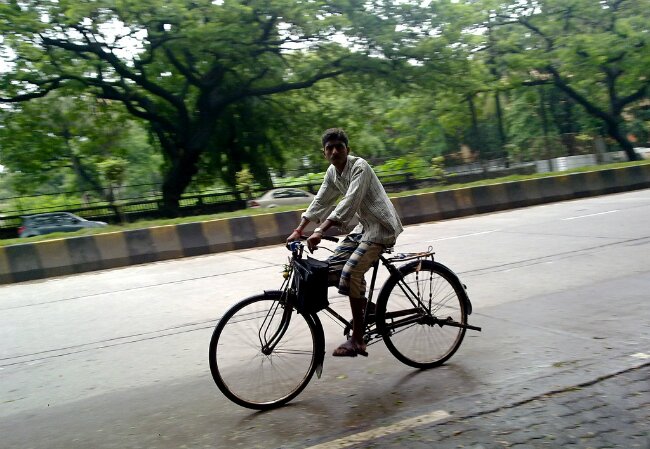
So far — in Mumbai, at least — it seems the car has taken precedence, leaving stranded the majority of residents for whom a car is out of reach. Alternatives are difficult at best. Sidewalks, if they exist, are often in disrepair or scattered with parked cars, vendors, or other impediments. Walking is cumbersome and even dangerous, and cycling can be a life-threatening endeavor.
Still, alternative-transportation advocates are hoping small-scale efforts to take back the streets will spread. In March, 600 cyclists descended on the streets on World Environment Day to encourage more people to bike to work. The initiative, called "Project Cycle2Work," hopes to attract more riders over the next year, and importantly, garner more support from city officials. Vijayshree Pednekar, a transport planner who helped organize Project Cycle2Work, emphasizes the idea of bicycle commuting as a low-cost, quick-to-launch initiative in a city focusing efforts on expensive, long-term and heavy infrastructure. She also champions needed for bike-sharing programs that could link to public transport.
Getting Mumbaikers out of their cars will require that more sustainable options be attractive. While the Mumbai local trains run with remarkable efficiency, they continue to be scarily overcrowded and in need of commuter-friendly upgrades such as air conditioning — a promise that has been continually postponed. Station stops should be connected with bike-sharing programs or walkways that aren't elevated (another sign that streets now prioritize cars). None of these environmentally-friendly options, however, will work in isolation. A thoughtful, integrated plan for the city's commuters must be a priority in the gridlocked city.
Mumbai is in need of a sea change — a move toward options that make carless commuting comfortable, safe, and fast. If the car-free Sundays are any indication, Mumbaikers are ready for alternatives — now it's time for policy to build on the excitement out in the streets.
Photo: Satish Krishnamurthy
Permalink to this discussion: http://urb.im/c1507
Permalink to this post: http://urb.im/ca1507mme